
Aurebesh Translator – Convert English to the Star Wars Alphabet
Loading local glyph font. The preview will appear when it is ready.
Turn English words, names, slogans, and sentences into Aurebesh, the alphabet seen across the Star Wars galaxy. Our Aurebesh translator also supports conversion back into Latin letters, with the traditional 26-letter alphabet and eight optional digraph characters.
Below the tool, you can check the complete character reference, see worked examples, and learn how Aurebesh is used in Star Wars and in digital text.
How to Use the Aurebesh Translator
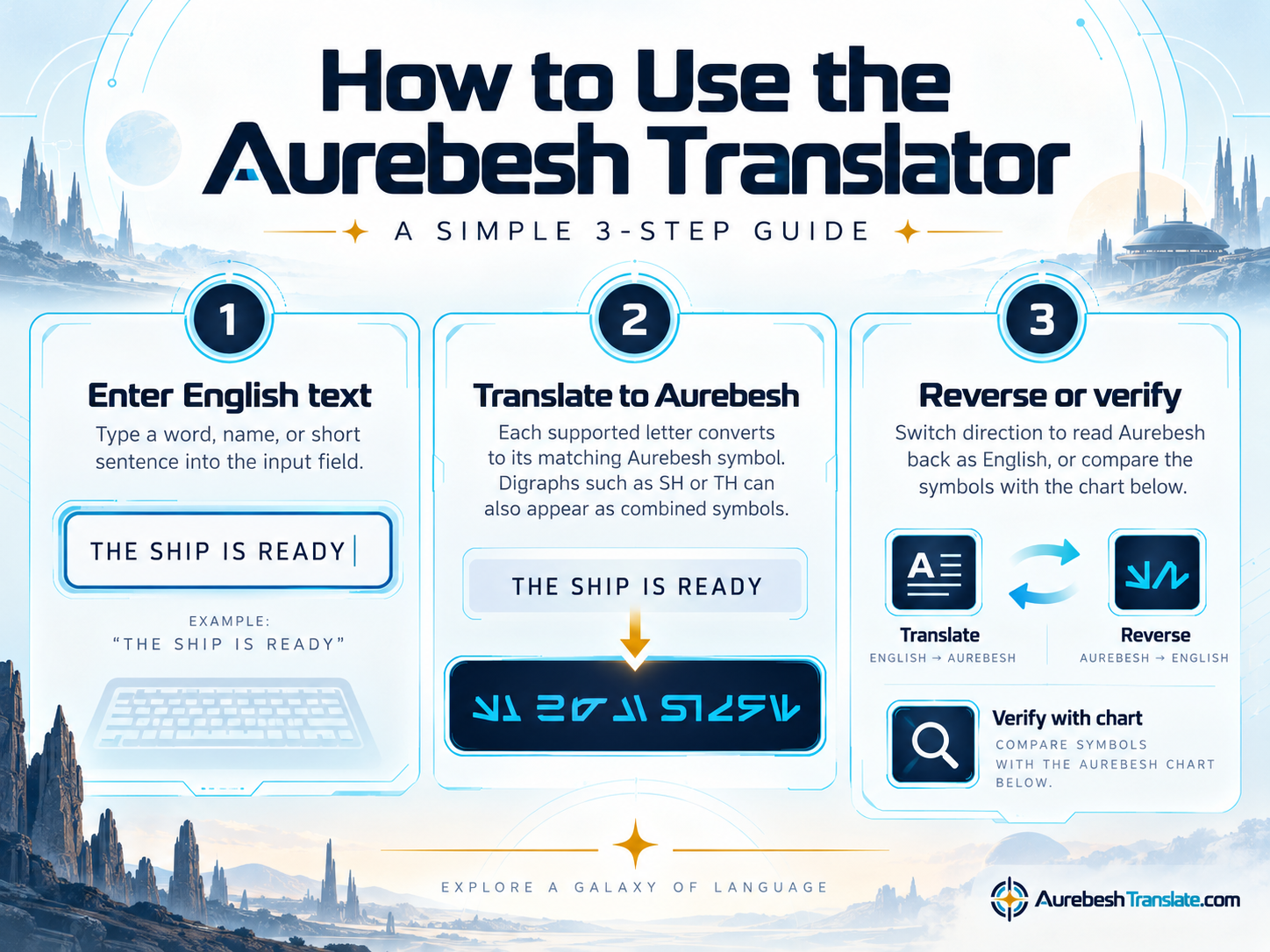
Translate English to Aurebesh
Enter a word or sentence in the input field to see it displayed using Aurebesh lettering. Try JEDI, TATOOINE, or THE SHIP IS READY. Word spacing is retained, and the eight traditional two-letter symbols can be used where appropriate.
For a word such as SHIP, you can represent S and H separately or use the combined character Shen (SH). Both forms preserve the original spelling.
Convert Aurebesh Back to English
Choose the reverse direction to read supported Aurebesh text as Latin letters. A basic symbol represents one letter; a combined character such as Thesh represents TH. If you are working from a photograph, use the alphabet chart to identify the visible symbols first. A photograph itself is not editable character input.
What Is Aurebesh?
Aurebesh is a fictional writing system used for Galactic Basic Standard in Star Wars. Its angular letters appear on signs, control panels, vehicles, and equipment. Unlike a separate spoken language, it supplies written symbols for words that can already be spelled with Latin letters.
Aurebesh and Galactic Basic
Galactic Basic is the widely used language of the setting; Aurebesh is one way to write it. A sign reading REBEL BASE keeps those words and their meaning when its letters are shown in Aurebesh. This distinction explains why familiar English words and newly invented names can both be represented.
Where the Name Aurebesh Comes From
The first two letters are Aurek (A) and Besh (B). Combining their names produces Aurebesh, much as the word alphabet comes from alpha and beta. Each character has a conventional name, but readers decode the letters they represent rather than spelling out those names.
The Aurebesh Alphabet: Letters, Names, and Symbols
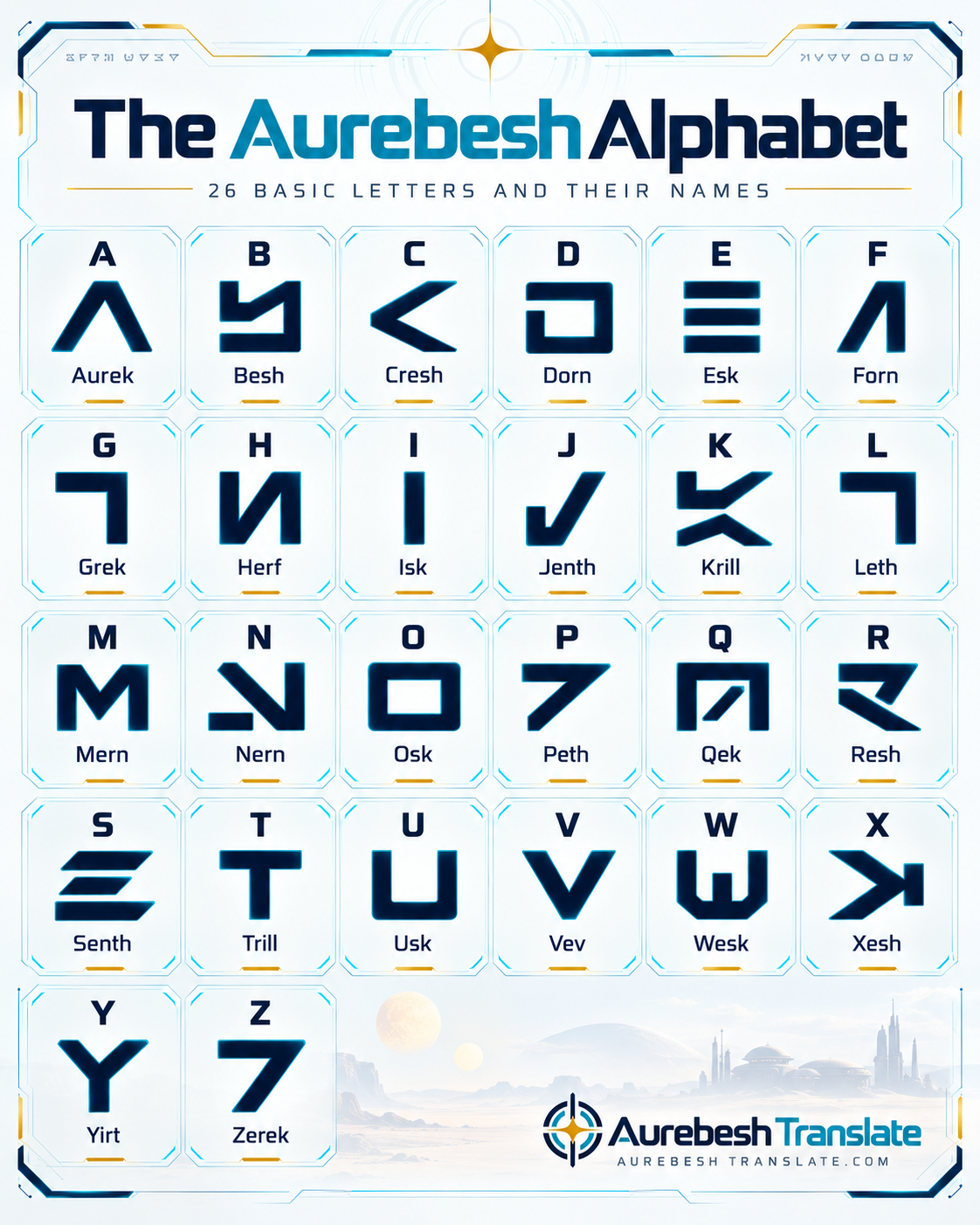
The established alphabet contains 26 single-letter characters, plus eight additional symbols for particular letter pairs. The chart below displays the A–Z equivalents, names, and actual glyphs rendered from the supplied AurebeshTranslate Regular font.
The 26 Aurebesh Letters and Their English Equivalents
| English | Aurebesh glyph | Character name |
|---|---|---|
| A | Aurek | |
| B | Besh | |
| C | Cresh | |
| D | Dorn | |
| E | Esk | |
| F | Forn | |
| G | Grek | |
| H | Herf | |
| I | Isk | |
| J | Jenth | |
| K | Krill | |
| L | Leth | |
| M | Mern | |
| N | Nern | |
| O | Osk | |
| P | Peth | |
| Q | Qek | |
| R | Resh | |
| S | Senth | |
| T | Trill | |
| U | Usk | |
| V | Vev | |
| W | Wesk | |
| X | Xesh | |
| Y | Yirt | |
| Z | Zerek |
Aurek through Zerek correspond to A through Z in order. For instance, JEDI uses Jenth, Esk, Dorn, and Isk, while NOVA uses Nern, Osk, Vev, and Aurek. The chart lets you inspect their shapes without guessing from English character names alone.
Understanding Aurebesh Letter Names
The names identify symbols unambiguously when discussing or checking lettering. Knowing that Resh is R matters more for decoding than memorizing the pronunciation of the name Resh. Typeface shapes may differ, but the intended letter equivalence should remain clear. The interactive Aurebesh alphabet lets you inspect characters individually and access a printable reference.
How Does English-to-Aurebesh Conversion Work?
Aurebesh conversion replaces supported written characters with their corresponding symbols. It does not need a separate dictionary entry for every word.
Letter-by-Letter Conversion
REBEL consists of R–E–B–E–L. Its Aurebesh characters are Resh–Esk–Besh–Esk–Leth in the same order. This simple relationship is the foundation of the script.
How Names, Words, and Sentences Are Converted
Place names, everyday words, and slogans follow that same sequence. In THE SHIP IS READY, the spaces keep the four words distinct. Some pairs can also be displayed as single digraph symbols, changing the number of visible glyphs without changing the spelling.
Unsupported Letters and Special Characters
The established A–Z repertoire does not supply dedicated basic letters for every accent or non-Latin writing system. For a name originally written in another script, first choose its intended Latin spelling. Different romanizations can produce different Aurebesh letter sequences.
The Eight Aurebesh Digraphs and How They Work
Eight additional characters each represent two Latin letters. These are traditional Aurebesh digraphs, not extra sounds that change the meaning of a word.
The Eight Two-Letter Combinations
| English | Aurebesh glyph | Character name |
|---|---|---|
| AE | Enth | |
| CH | Cherek | |
| EO | Onith | |
| KH | Krenth | |
| NG | Nen | |
| OO | Orenth | |
| SH | Shen | |
| TH | Thesh |
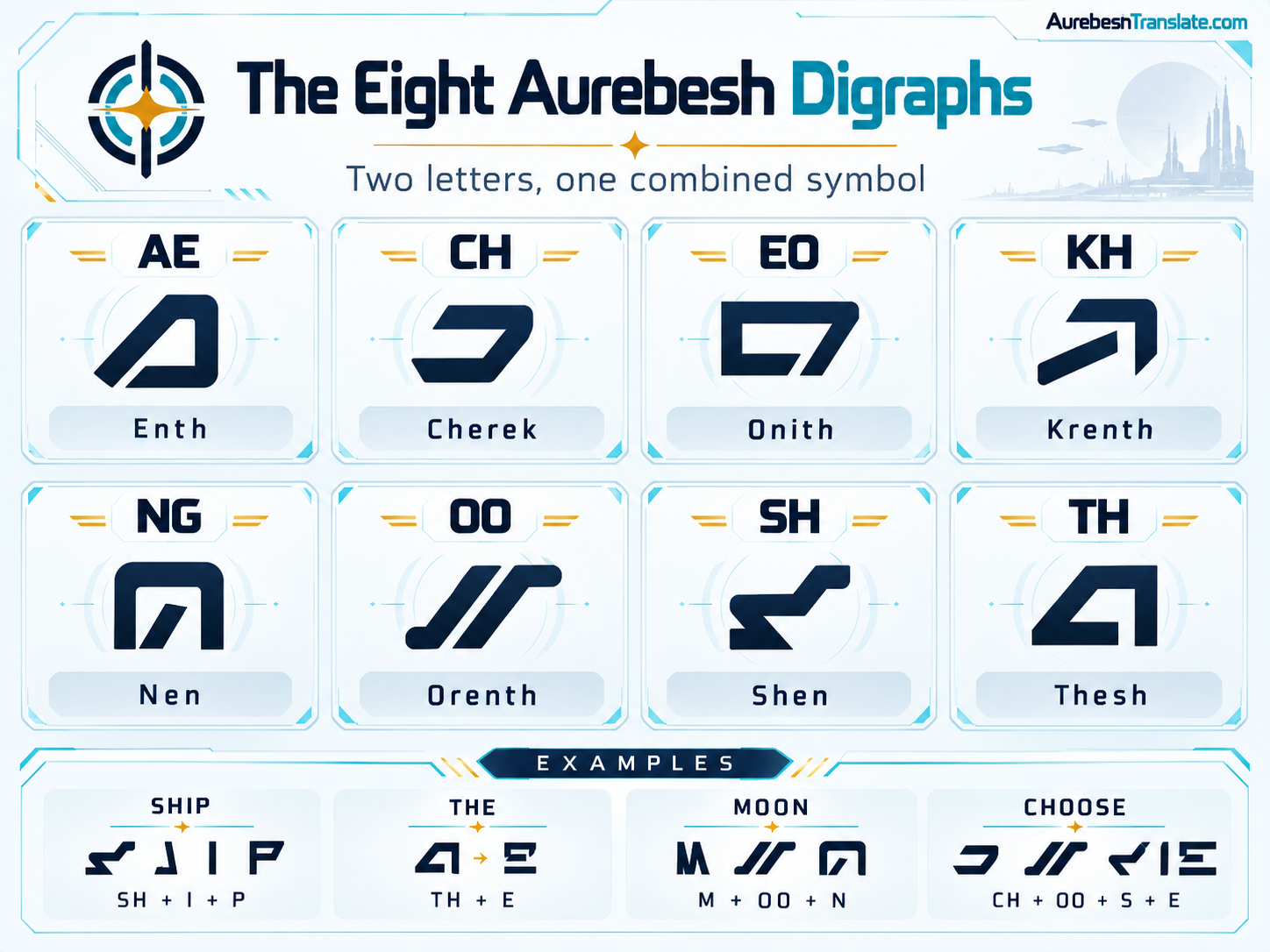
The pairs are AE (Enth), CH (Cherek), EO (Onith), KH (Krenth), NG (Nen), OO (Orenth), SH (Shen), and TH (Thesh). Each glyph in this chart comes from the supplied font rather than a substitute symbol from an unrelated Unicode script.
When Are Combined Aurebesh Symbols Used?
Use of digraphs is optional. MOON can be written with two Osk characters or one Orenth (OO); THE can begin with separate T and H or a single Thesh. The Aurebesh digraphs guide examines their character forms and more complex examples.
Aurebesh Translation Examples: Words, Names, and Sentences
| Original text | Possible character grouping | What to notice |
|---|---|---|
| JEDI | J + E + D + I | Four basic letters |
| SHIP | SH + I + P | Optional Shen character |
| MOON | M + OO + N | Optional Orenth character |
| CHOOSE | CH + OO + S + E | Two optional digraphs |
| TATOOINE | T + A + T + OO + I + N + E | A name with OO |
| THE SHIP IS READY | TH + E / SH + I + P / I + S / R + E + A + D + Y | Digraphs and word spacing |
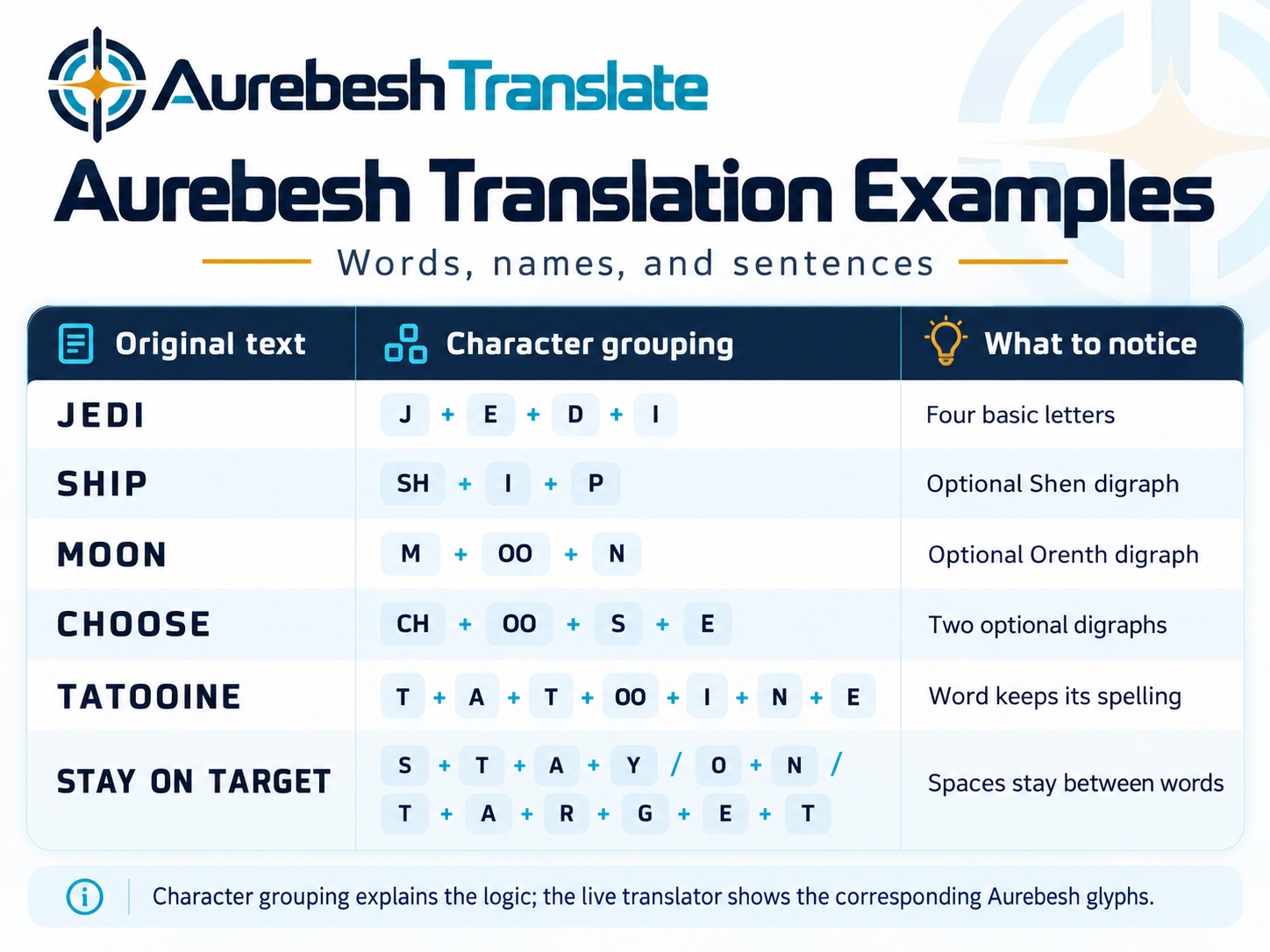
The plus signs separate characters for explanation; slashes mark spaces. These are Latin-letter breakdowns, not representations of the Aurebesh glyphs themselves. Use the translator above to see the corresponding writing.
How to Check the Accuracy of an Aurebesh Translation
A convincing-looking symbol is not necessarily the correct symbol. Check the intended word against the character sequence rather than judging only the visual style.
Correct Letter Mapping Versus Visual Style
A typeface may draw Resh with a different stroke weight or proportion without changing the fact that it means R. But substituting Peth (P) for Resh changes the actual letter. Similarly, separate T and H characters and the combined Thesh can both represent TH.
Common Translation and Lettering Mistakes
Look for omitted letters, extra glyphs, reversed word order, and inconsistent character forms. For a finished sign or piece of artwork, decode the complete inscription back into Latin letters and compare it with the source wording. This catches more errors than checking a few recognizable characters in isolation.
Aurebesh Writing Conventions
Reading Direction and Word Spacing
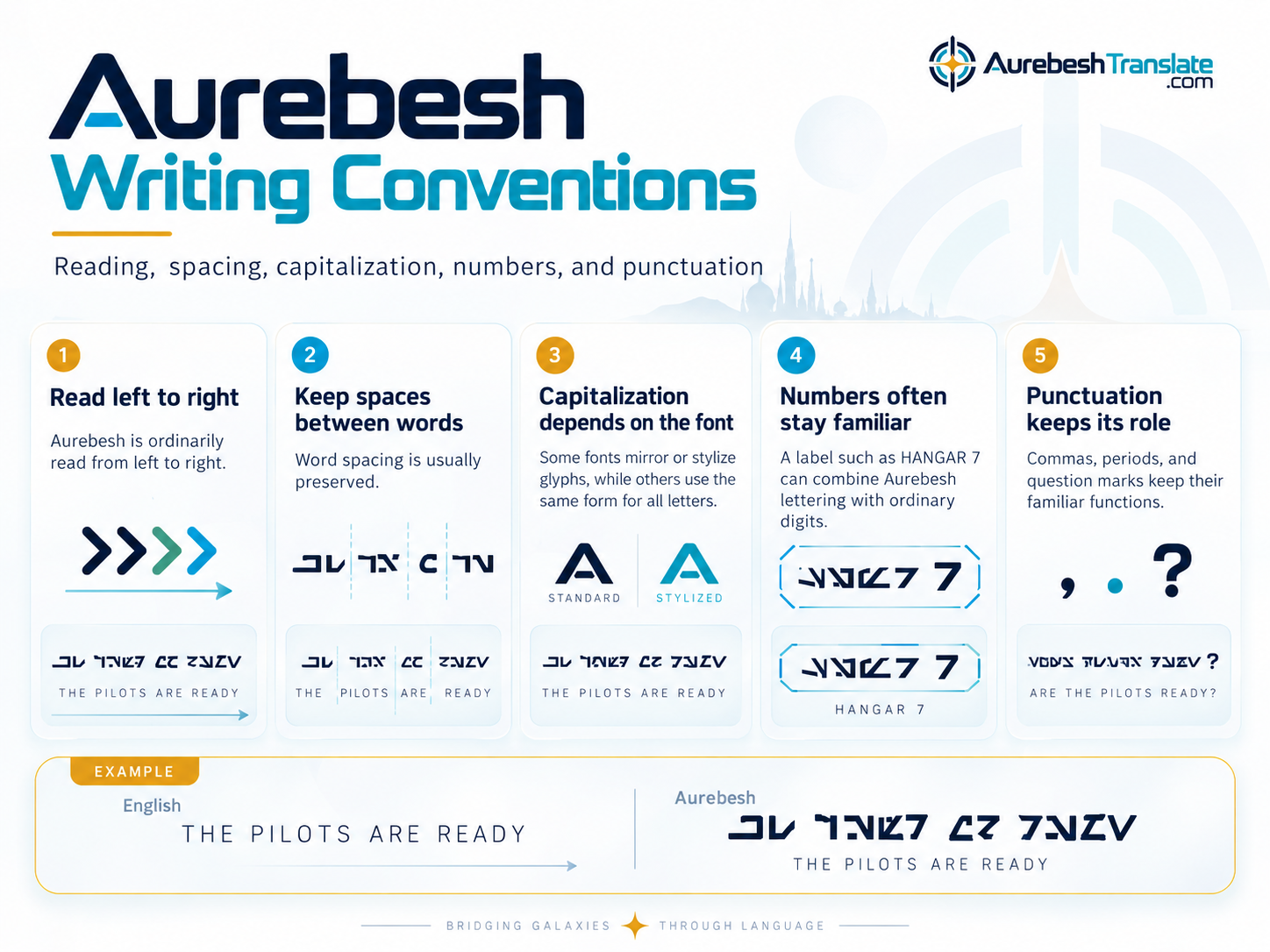
Aurebesh is ordinarily read left to right, with spaces between words. Vertical labels and stylized displays can change the visual arrangement, so establish the orientation of the complete inscription before reading individual characters.
Capitalization and Mirrored Letterforms
Aurebesh has no universal Latin-style pair of uppercase and lowercase alphabets. Some designs mirror glyphs to indicate capitals; others use the same letterform regardless of case. A mirrored shape should therefore be interpreted in its font or inscription context.
English Spelling and Grammar in Aurebesh
Plural endings, word order, and sentence punctuation come from the underlying language. For THE PILOTS ARE READY, the script supplies the visible letters; it does not call for different English grammar.
Aurebesh Numbers and Punctuation
Numbers in Aurebesh
Ordinary digits often appear alongside Aurebesh lettering in Star Wars material. Additional numeral styles exist, but they should not automatically be presented as part of the original 34-character letter repertoire. A label such as HANGAR 7 remains understandable with a conventional digit. See the Aurebesh numbers reference for the fuller treatment.
Punctuation and Other Written Symbols
Spaces, commas, periods, and question marks keep their familiar functions. Their visual appearance may follow the chosen font. Stephen Crane later expanded the published alphabet to include punctuation in Imperial Entanglements (1996), after the original 1994 alphabet publication.
How to Read and Write Aurebesh
Reading a Short Aurebesh Inscription
Identify the starting edge of a sign, then match each glyph with the reference chart. For PILOT, the sequence is Peth–Isk–Leth–Osk–Trill. If the number of symbols seems unexpectedly small, check whether a digraph is present. The How to Read Aurebesh guide offers more systematic practice.
Writing Names and Phrases in Aurebesh
Start with a confirmed Latin spelling, then arrange the matching symbols in order. Keep the letter height and spacing consistent, especially when adding short labels or multiword messages. The How to Write Aurebesh guide explains character construction and handwriting techniques.
Aurebesh Fonts, Unicode, and Copy-and-Paste
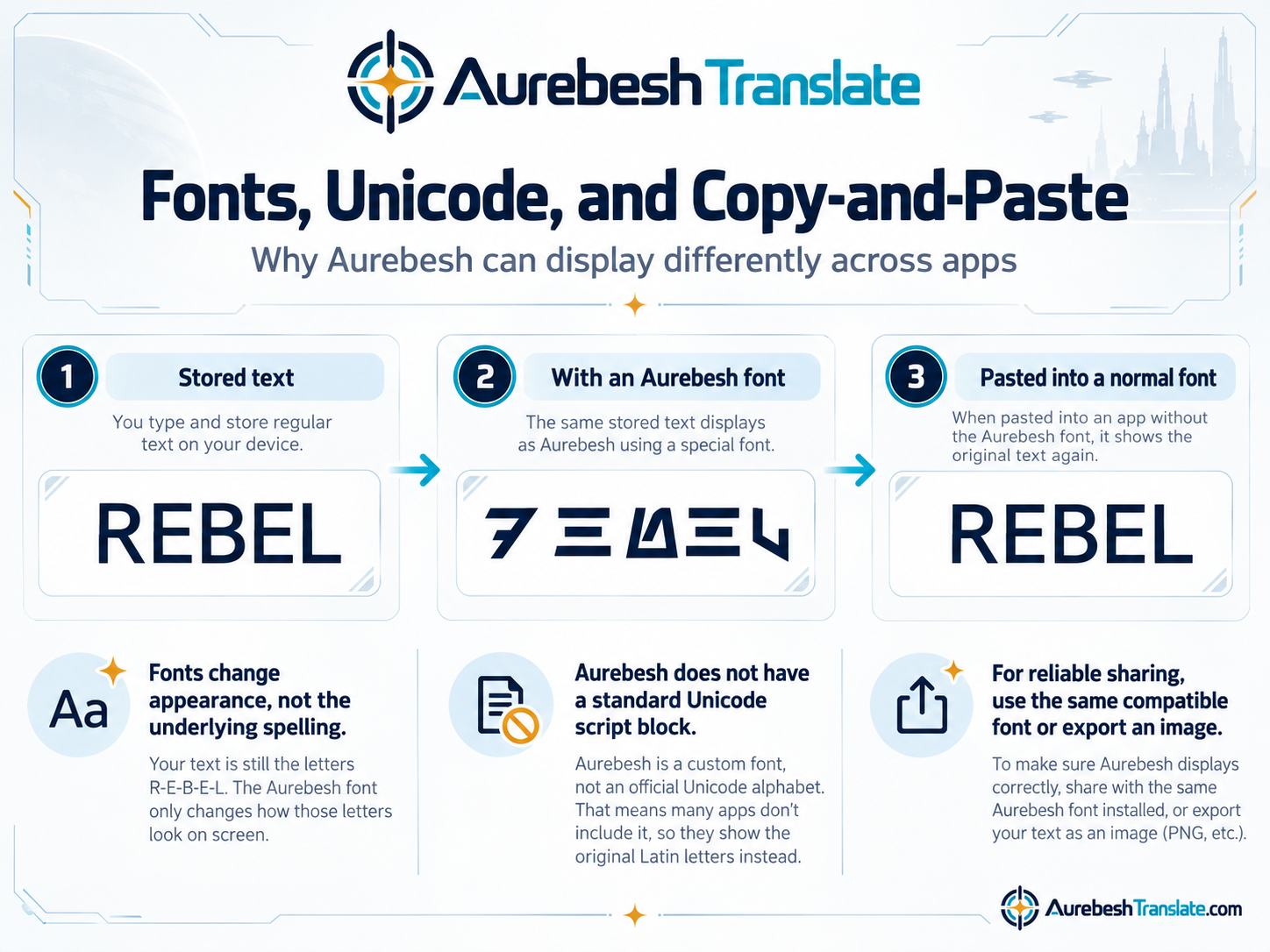
Digital Aurebesh can look correct on one screen yet appear different in another application. The key distinction is between the characters stored in text and the glyphs drawn by a font.
How Aurebesh Fonts Display Letters
A custom font can display ordinary Latin letters as Aurebesh shapes. A document that stores JEDI can therefore show four Aurebesh glyphs while the typeface is selected. The supplied AurebeshTranslate Regular package includes font files in TTF and OTF formats, with mappings for basic letters, digraph glyphs, digits, and common punctuation.
Does Aurebesh Have Standard Unicode Characters?
Aurebesh does not have its own standardized Unicode script block. Some font systems use Latin character codes; others use privately assigned positions. A private-use character is not a universal Aurebesh letter, so a compatible font or shared mapping may be needed to display it correctly.
Why Copied Aurebesh May Display as English
Copying font-rendered text usually transfers the stored characters rather than a picture of the displayed glyphs. If REBEL was stored as Latin text, pasting into an ordinary font may show REBEL again. The Aurebesh Unicode and copy-and-paste guide explains how to recognize and handle these differences.
When to Use Text, Fonts, or Images
Use editable text with a compatible font when you expect to revise a message. Use a rendered image when its visual appearance must remain unchanged on another device. A reference chart is better for identifying individual letters than for editing a sentence.
The Origin and History of Aurebesh
Early Star Wars Screen Lettering
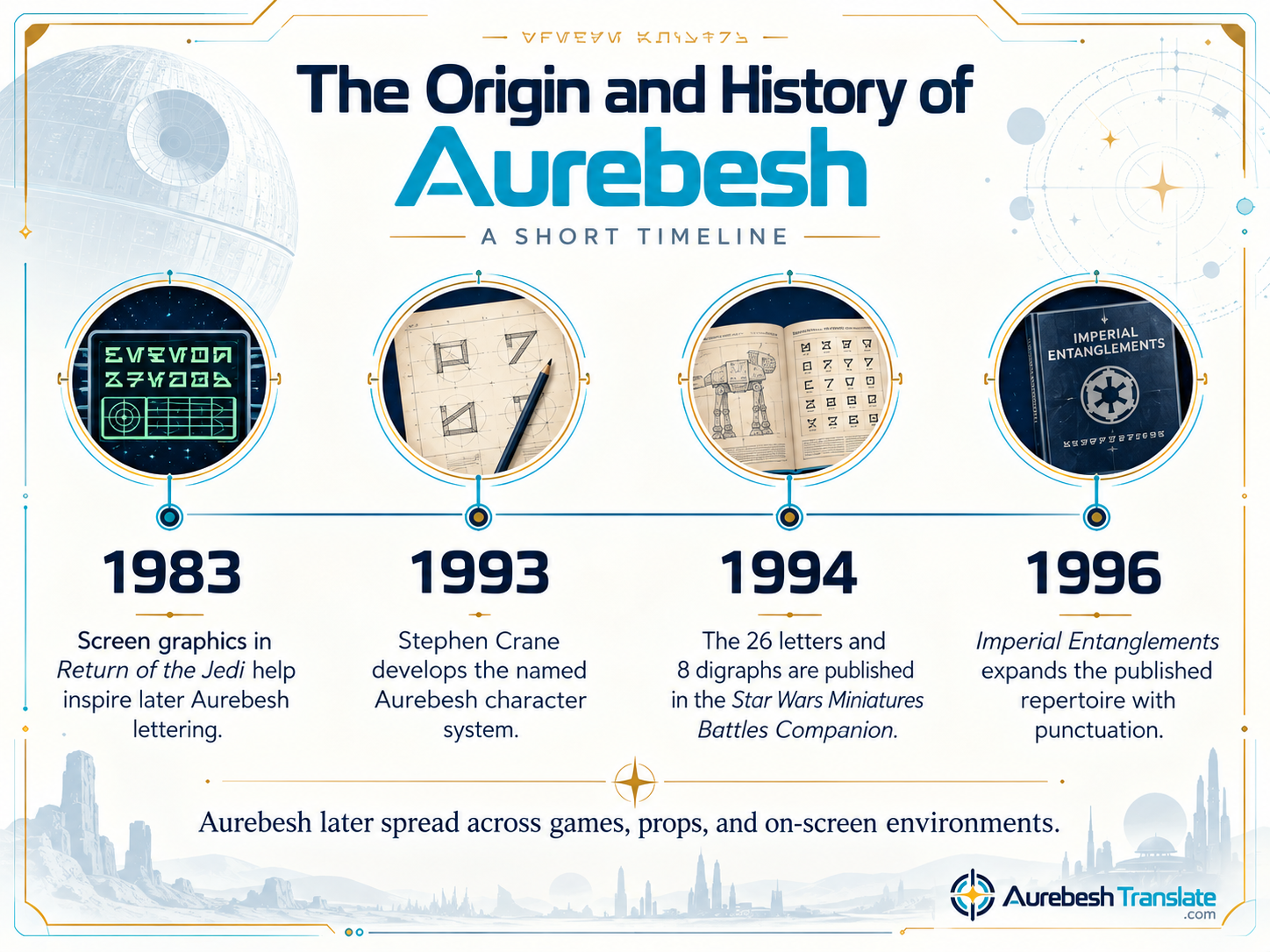
The angular graphics seen on computer displays in Return of the Jedi (1983) helped inspire the later Aurebesh alphabet. Those film graphics were not originally distributed as a complete A–Z learning chart.
Stephen Crane and the Development of Aurebesh
Stephen Crane developed the named character system for West End Games in 1993. Its 26 letters and eight digraphs appeared in the Star Wars Miniatures Battles Companion (1994). The later Imperial Entanglements supplement (1996) expanded the available punctuation.
How Aurebesh Spread Across Star Wars Media
A consistent alphabet made it possible for later productions to place readable warnings, signs, and background messages into Star Wars environments. Different visual treatments emerged over time, while the recognizable character system remained useful. Our history of Aurebesh covers the chronology and source material in greater depth.
Where Is Aurebesh Used in Star Wars?

Practical Uses for Aurebesh: Names, Slogans, Props, and Fan Art
Aurebesh works particularly well for concise, meaningful lettering. A personal name can retain its familiar spelling in a Star Wars style. A slogan such as STAY ON TARGET can become a poster headline. Props can carry functional labels such as CARGO HOLD or ENGINE STATUS, while fan art can use short inscriptions as supporting visual detail.
Choose the wording first, check the glyph sequence, and confirm that it is readable in the final design. For more examples of short messages, visit the Aurebesh phrases reference.
Explore More Aurebesh Tools and Learning Resources
Interactive Aurebesh Alphabet and Printable Chart
Use the alphabet resource to examine individual characters, compare their English equivalents, and print a reference sheet for study. It adds interactive exploration to the complete static charts on this page.
Aurebesh Keyboard
The Aurebesh keyboard is designed for selecting characters and composing text directly, with editing and image-output functions for finished lettering.
Downloadable Aurebesh Fonts
The Aurebesh fonts resource is the place to obtain the site’s TTF and OTF font files and installation instructions for compatible desktop applications.
Frequently Asked Questions About Aurebesh Translation
Can I Translate Aurebesh from an Image or Screenshot?
An image contains rendered shapes, not editable character input. You can decode it manually by comparing visible glyphs with the alphabet chart and reading the letters in sequence. Unclear, stylized, or partly hidden characters may require examining the surrounding word.
Can Aurebesh Translate Other Star Wars Languages?
Aurebesh is a writing system associated with Galactic Basic, not a universal translator for Huttese, Mando’a, or other fictional languages. Representing a word in Aurebesh does not change that word’s language or meaning.
Can I Write Non-English Names in Aurebesh?
Yes, when you have an appropriate spelling in supported Latin letters. Names written in Arabic, Cyrillic, or other scripts may have more than one romanization, so confirm the version you intend to display before converting it.
Why Might Reverse Conversion Produce a Different Result?
A difference in appearance may come from the font or from optional digraphs: one Thesh and separate T + H both represent TH. If the actual Latin spelling differs, compare the source glyphs against the reference chart and check that no characters were omitted or rearranged.