Aurebesh Numbers: Digits 0–9 and Alternate Star Wars Numerals
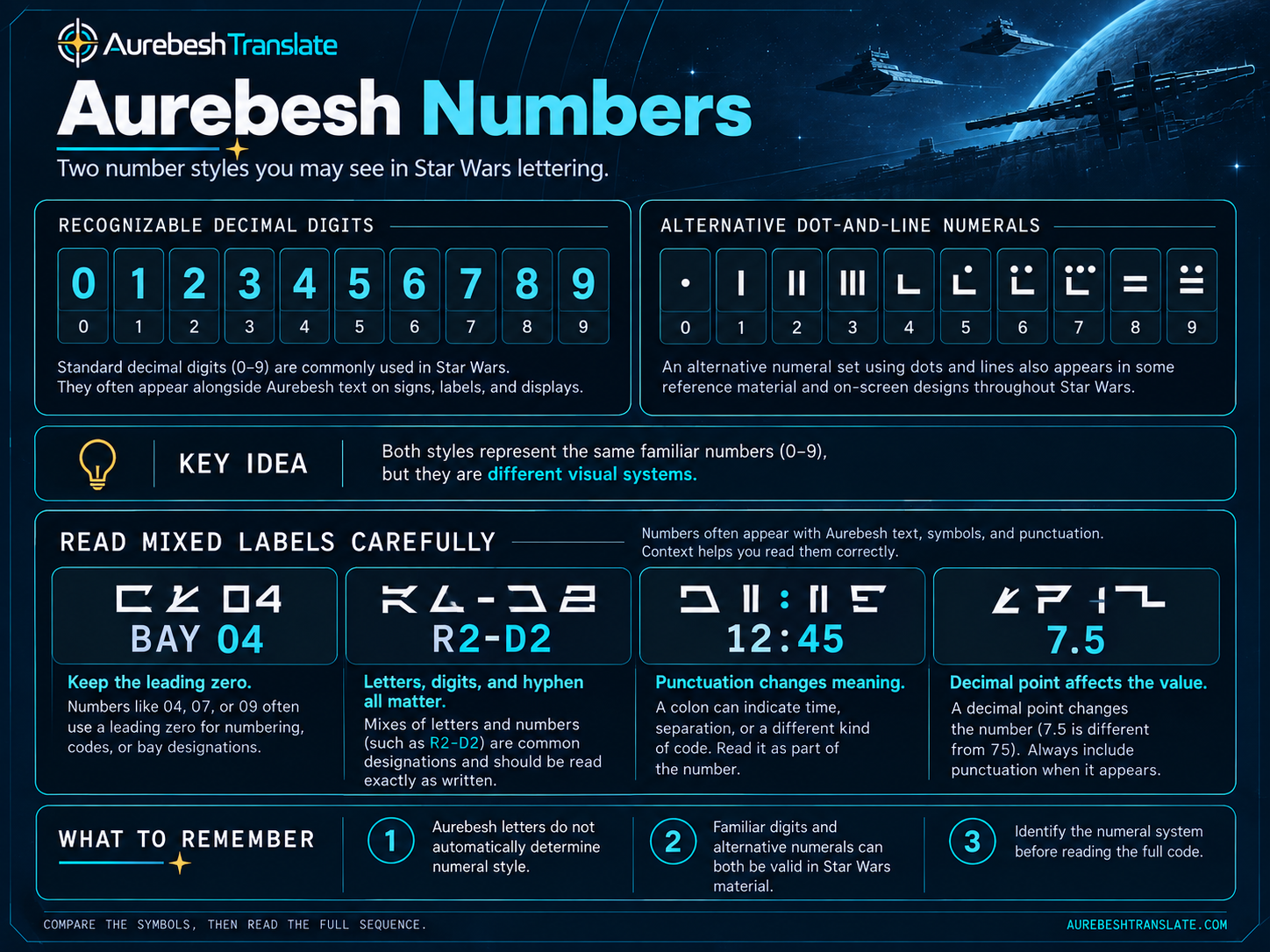
Aurebesh numbers are less uniform than the letters of the Star Wars alphabet. Ordinary decimal digits 0–9 often appear alongside Aurebesh writing, while some Star Wars sources use an alternative set of numeral symbols built from dots and lines. Both styles can represent familiar numbers; they should not be mistaken for two different methods of counting.
If you’re reading a hangar label, droid designation, or number on a fictional display, the first question is which numeral style the inscription uses. The surrounding Aurebesh letters can help identify a word, but they do not determine what every unfamiliar numerical symbol means.
How Are Numbers Written in Aurebesh?
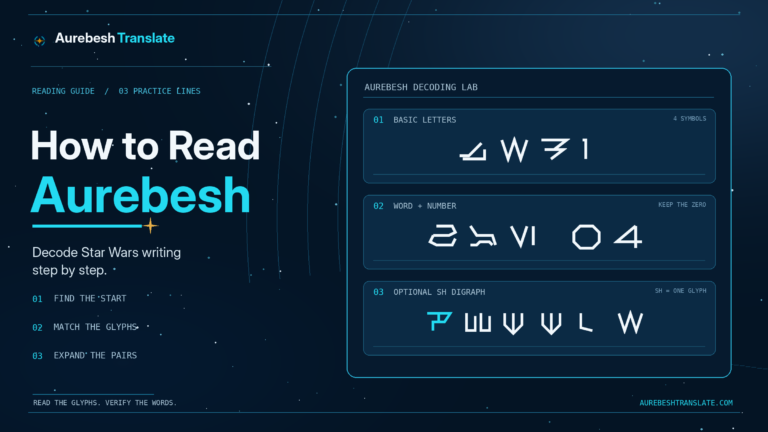
The most straightforward convention is to use the familiar digits 0, 1, 2, 3, 4, 5, 6, 7, 8, and 9 alongside Aurebesh lettering. A word may use the fictional alphabet while a number beside it remains readily recognizable.
For example, a label reading BAY 04 can have BAY written with Aurebesh letters and the digits 0 and 4 displayed in an ordinary or slightly stylized numeral design. There is no need to spell out zero four as Aurebesh letters merely to include a number.
These are decimal digits, so their usual place values still apply. 12 represents twelve, 120 represents one hundred twenty, and 1,205 represents one thousand two hundred five. Replacing the lettering style does not change the numerical value.
This convention has a historical basis. When Stephen Crane developed the named Aurebesh alphabet in 1993, he did not create a separate set of digits for it. The Return of the Jedi computer displays that helped inspire the alphabet included familiar numerical characters. The original 26 letters and eight digraphs therefore should not be counted as a 44-character alphabet simply by adding an assumed set of ten numerals.
The Alternative Dot-and-Line Aurebesh Numerals
There is, however, another numeral system associated with Star Wars. It uses combinations of dots and short lines rather than the familiar outlines of 0–9. These symbols have appeared in reference material and subsequent productions, which explains why an Aurebesh number chart found online may look quite different from the digits beside an ordinary Aurebesh inscription.
The middle column shows the actual digit glyphs in AurebeshTranslate Regular. The right column reproduces the documented 0–9 alternative forms associated with Peter Schuster’s New Aurabesh. The two styles are not interchangeable font designs: their numeral shapes have different histories.
Where the Alternative Designs Came From
The dot-and-line notation appeared in the 1995 West End Games supplement Platt’s Starport Guide, in a graphic showing a starship transponder-code profile. The original chart included values from 0 through 16. Related artwork was reused in other West End Games publications.
In 1998, Peter Schuster incorporated digit versions of these symbols into his fan-made New Aurabesh font. Later use commonly focuses on the ten digits 0–9.
An important distinction: a chart containing values 0 through 16 does not establish that Aurebesh uses a base-17 counting system. Those numbers were labels on the original graphic. The use of distinctive symbols should not be confused with proof of an entirely different arithmetic system.
Why Two Charts May Disagree
A chart showing familiar decimal digits and another showing dot-and-line shapes may both reflect real uses of numerals in Star Wars-related material. The disagreement arises when either chart is presented as the only authentic option.
The traditional Aurebesh letter mappings are comparatively well defined. Numeral appearance has varied more substantially across publications, productions, and font designs. A faithful reference needs to identify which numbering style it is showing and where that style comes from.
Where Do Alternative Aurebesh Numbers Appear in Star Wars?
A notable example is the 7189 mural on Lothal in Star Wars Rebels. The number appears in the alternative numeral style, with Aurebesh lettering underneath. Lucasfilm’s official Spark of Rebellion concept-art gallery offers production artwork associated with the setting.
The alternative symbols also appear in later Star Wars material, including numerical markings in Solo: A Star Wars Story. A gate inscription on Kessel combines Aurebesh letters and alternative numerals in an alphanumeric identifier. Published transcriptions disagree on one character, so the exact code is best left unasserted without a clear frame.
These examples are useful because the numbers are part of identifiers, not arithmetic problems. The reader must recognize which marks are letters, which are numerals, and where the code’s spaces belong. They also show why the presence of familiar digits in one scene does not invalidate the alternative forms in another.
Reading Numbers in Names, Signs and Technical Codes
Numerals are often mixed with letters or punctuation. The examples below are illustrative layouts, not claims that a particular sign appears in an official production.
| Example | How to interpret the number | Detail to preserve |
|---|---|---|
| BAY 04 | Bay identifier 04 | The leading zero is part of the label |
| R2-D2 | Droid designation | Both digits and the hyphen matter |
| SECTOR 12 | Sector number twelve | Lettering and digits form one label |
| CARGO 250 | A quantity or coded value, depending on context | Do not guess units that are not shown |
| 12:45 | A time-style notation | The colon separates two numerical groups |
| 7.5 | A decimal value | The decimal point affects the value |
Leading Zeros and Letter–Digit Lookalikes
A leading zero does not change a number’s mathematical value: 04 and 4 both represent four. But it can matter in a label, serial number, or access code. If you are reproducing BAY 04, dropping the zero changes the identifier’s written form.
Stylized fonts introduce another problem. A digit 0 may resemble a rounded letter O, while 1 can be mistaken for a vertical stroke in a letter. Compare the symbol with nearby text and, when possible, the specific font or reference used by the inscription. A plausible word is not enough to prove that an ambiguous character is a letter rather than a digit.
Punctuation Around Numbers
Hyphens, decimal points, colons, commas, and percent signs can be necessary to understand numerical information. 1,500, 1.500, and 1500 may be interpreted differently depending on formatting conventions, even if all three contain the same digits.
When preparing Aurebesh-style signage, preserve punctuation deliberately and make sure the selected font renders it clearly. Punctuation is not another numerical digit; it provides structure around the number.
How AurebeshTranslate Regular Displays Digits
The site’s original AurebeshTranslate Regular font contains glyphs for 0–9 as well as common punctuation. Its numeral outlines are geometric, stylized versions of recognizable decimal digits. They are not the historical dot-and-line alternatives described above.
That means text such as HANGAR 12 can be set in a consistent typeface without implying that the number 12 belongs to the original 34-character letter-and-digraph repertoire. The underlying digits remain ordinary text characters, which is useful when revising codes or labels in a compatible desktop application.
The Aurebesh keyboard is useful when composing and exporting short lettering as an image. For complete English text, including words combined with numbers, the site’s Aurebesh translator is the main conversion tool. Neither resource should be taken as proof that every fictional numeral design across Star Wars uses the same glyph shapes.
Which Aurebesh Number Style Should You Use?
Choose the style according to the source you are trying to reproduce.
If you are making a readable label using the site’s font, its familiar geometric 0–9 characters are a consistent choice. You can type and edit them alongside Aurebesh letters without needing an alternative numeral reference.
If you are recreating a particular sign, costume detail, game interface, or prop, inspect the original appearance instead. A source that uses the dot-and-line digits should be matched against a verified reference for that numeral system, not replaced with arbitrary decorative symbols.
For identifying an unknown number, work in this order: establish the orientation, separate letters from numerical marks, determine which digit design is in use, and only then read the full sequence. The surrounding words may help with context, but the numeral shapes must support the reading.