
Aurebesh Alphabet: Complete A–Z Chart, Letter Names and Symbols
Eight optional digraph forms (not mandatory when writing Aurebesh):
Loading local glyph font. The character names and English keys remain available.
The Aurebesh alphabet is the recognizable writing system used for Galactic Basic in Star Wars. Its traditional character set contains 26 letters corresponding to A–Z and eight additional symbols for specific letter pairs. Use the interactive chart below to examine the actual glyphs, find their names and English equivalents, and print a reference sheet for later use.
Each symbol in the chart represents a letter or a defined two-letter combination. If you want to convert an entire word or sentence rather than inspect individual symbols, use our Aurebesh translator.
How to Use the Interactive Aurebesh Alphabet Chart
The reference is arranged in two groups: the 26 basic letters first, followed by the eight optional digraph characters. Every entry shows its Aurebesh glyph, Latin-letter equivalent and character name. The shapes displayed come from the site’s own Aurebesh font, so you can examine the lettering itself rather than relying on text descriptions.
Select a character to see it more prominently alongside its name and English key. The Copy English key control copies the Latin letter or letter pair represented by that symbol. It does not copy a universally portable Aurebesh Unicode character.
For quick lookups, start with the English letter you know. For unfamiliar lettering, work in the opposite direction: compare the visible glyph with the chart, then check the associated Latin equivalent. If you cannot find a match among the 26 basic letters, examine the eight digraphs before assuming that the symbol belongs to a different alphabet.
The 26 Aurebesh Letters, A to Z
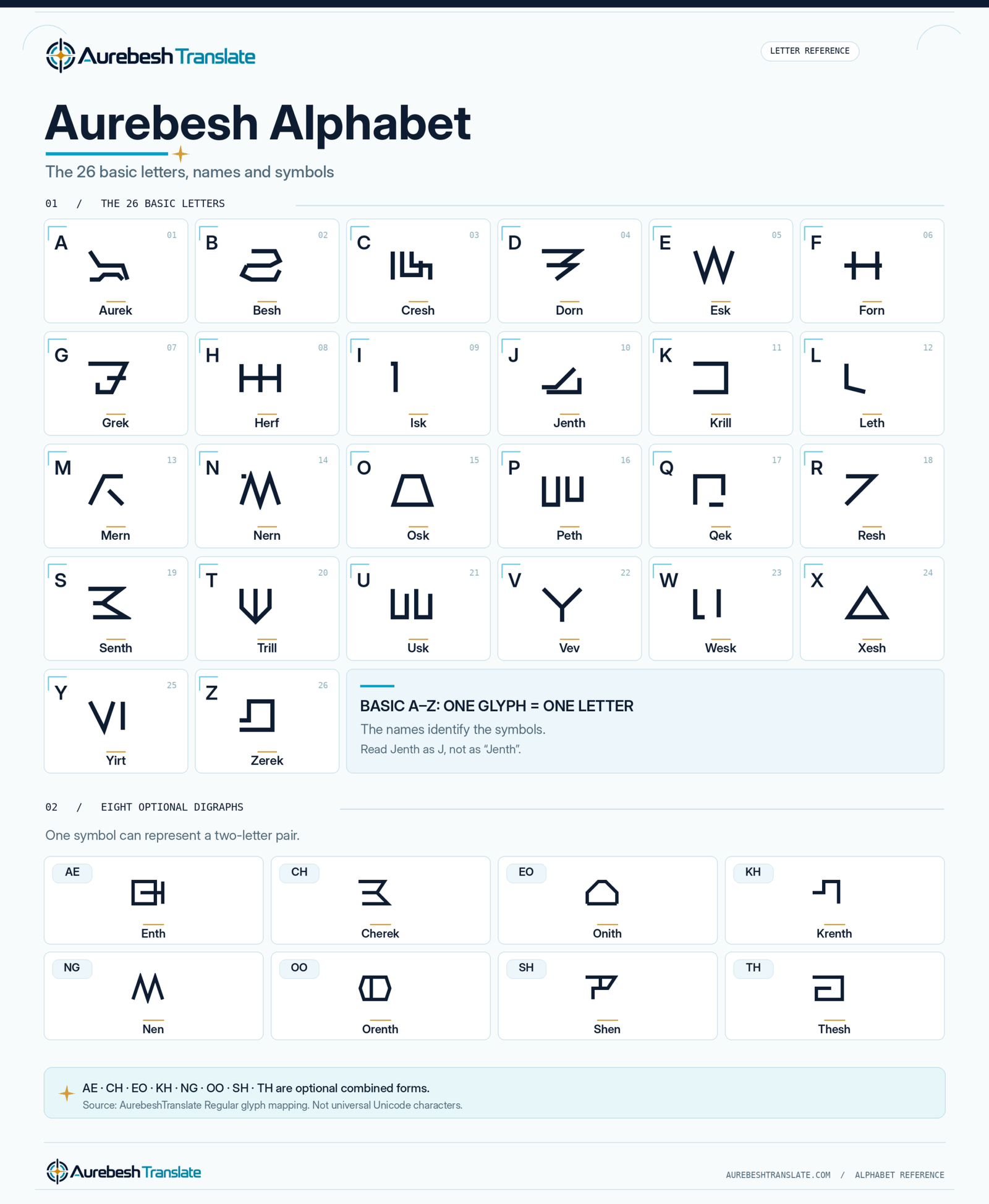
The basic alphabet maps one Aurebesh glyph to each Latin letter. The first four entries, for example, are Aurek (A), Besh (B), Cresh (C) and Dorn (D). The sequence ends with Wesk (W), Xesh (X), Yirt (Y) and Zerek (Z).
The names identify the symbols; they are not extra letters to insert into a word. If you see Jenth, you read J, not the five-letter name Jenth. A word spelled JEDI uses four basic symbols: Jenth, Esk, Dorn and Isk.
What the Character Shapes Tell You
Aurebesh has a strongly angular visual style, but its letters should be recognized by their identities rather than by a general resemblance to English capitals. Some glyphs are simple; others contain short strokes, forks or corners that are easy to miss at a small size.
In the AurebeshTranslate font used in this chart, Osk has a trapezoid-like outline, while Xesh is triangular. Forn and Herf both feature vertical strokes and connecting bars, but their arrangements differ. These are useful visual checks when learning this particular typeface, not rules that every Star Wars font must draw identically.
Look at a symbol’s full outline before deciding which letter it represents. A missing short stroke, a reflection, or an unfamiliar font style can make two characters seem closer than they really are.
Why Aurebesh Letters Have Names
The word Aurebesh joins the names of its first two letters, Aurek and Besh, much as alphabet comes from alpha and beta. Names provide a consistent way to identify the characters when discussing a chart or checking an inscription.
They do not provide a separate pronunciation system for the words being written. Knowing that Trill represents T is what lets you read a word; saying the character name aloud is optional terminology, not part of decoding the text.
The Eight Extra Aurebesh Characters
The traditional alphabet also includes eight digraphs, each representing two Latin letters with one glyph. All eight appear in the second part of the interactive chart.
| Latin pair | Character name | Example of the pair |
|---|---|---|
| AE | Enth | AEROSPACE |
| CH | Cherek | CHAIR |
| EO | Onith | LEON |
| KH | Krenth | KHAN |
| NG | Nen | RING |
| OO | Orenth | MOON |
| SH | Shen | SHIP |
| TH | Thesh | THIS |
These examples identify letter sequences, not recommended pronunciations. A name or word can contain the matching letters without requiring the combined symbol.
For instance, SHIP may be displayed as SH + I + P using Shen, or as S + H + I + P using separate basic letters. Both forms preserve the spelling. Some fonts and Star Wars inscriptions use the combined characters; others do not. The eight digraphs are established options, not mandatory substitutions.
The dedicated Aurebesh digraphs guide examines those choices and their more difficult edge cases. For alphabet lookup, the key point is simple: one visible glyph may correspond to two Latin letters.
How to Recognize Aurebesh Letters More Reliably
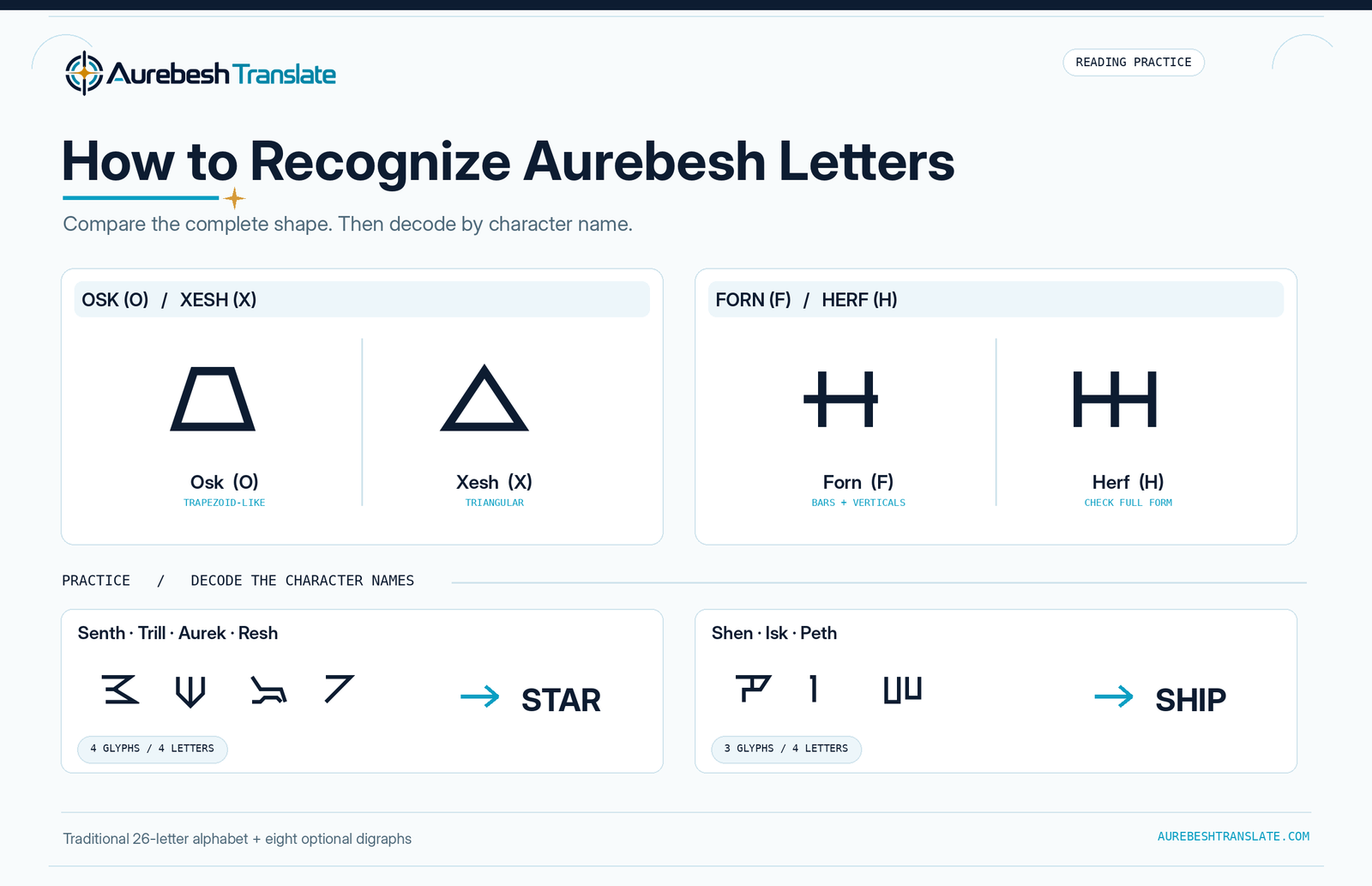
Reading from a character chart is easiest when you compare complete forms instead of guessing from one familiar-looking stroke. The following approach is useful for names, labels and short inscriptions:
- Establish the reading direction. Ordinary Aurebesh runs left to right. A rotated sign or decorative layout may require reorienting the text first.
- Identify individual glyphs. Compare their corners, bars and overall outlines with the chart. Do not infer a letter solely because it resembles a Latin character.
- Check for a digraph. If a symbol does not match the basic A–Z set, inspect the eight extra characters. The resulting Latin text may have more letters than the inscription has glyphs.
- Read the complete sequence. Use word spaces to separate words and recheck any uncertain character rather than changing the spelling to fit a guess.
A Short Character-Name Exercise
Try decoding this sequence of character names before checking the answer:
Senth · Trill · Aurek · Resh
It represents STAR. Now try Shen · Isk · Peth: the answer is SHIP, because Shen accounts for the letters SH together.
For longer inscriptions and graduated reading practice, continue with How to Read Aurebesh.
Print an Aurebesh Alphabet Reference Sheet
Use Print reference sheet above the chart to print its character reference through your browser’s print controls. The sheet includes the 26 basic letters and the eight optional digraphs, so it remains useful even when you are not viewing the interactive page.
For a legible printout, choose a scale that keeps small character strokes distinct. If your printer settings offer background graphics or print scaling, check the preview before printing. The glyphs should remain recognizable, and the English keys and names should be easy to read beside them.
A physical reference is useful when examining lettering on another screen or practicing character recognition. Keep the chart nearby, but try identifying a symbol before looking at its label; recognition develops more quickly when the answer is not always visible at first glance.
Letters, Numbers and Different Aurebesh Styles
The 34 entries in this chart form the traditional letter-and-digraph repertoire. Some expanded or fan-made charts include extra combinations, but those additions should not be mistaken for the original eight digraphs. Numbers and punctuation are used alongside Aurebesh without becoming additional basic alphabet letters. The Aurebesh numbers reference addresses numeral forms separately.
You may also see a familiar letter drawn differently in another game, production, or font. Letter weight, spacing, decorative details and mirrored forms can vary. A glyph’s correspondence to its Latin letter is the essential reference point; the exact contours of a particular font are not always universal.
Aurebesh is not the only writing system appearing in Star Wars. If an inscription has shapes that do not fit the chart even after accounting for stylization, see Aurebesh versus other Star Wars scripts rather than forcing an incorrect A–Z reading.
For a documented example of readable Aurebesh in the fictional setting, StarWars.com identifies lettering on a pilot’s ejection-seat handle in Star Wars Resistance. The message is legible because the characters correspond to actual letters, not just a decorative pattern.
Using the Alphabet Beyond the Reference Chart
Use this page when you need to identify or compare individual symbols. When you have moved from recognizing characters to making a complete piece of text, the next resource depends on your task.
If you want to assemble characters manually, the Aurebesh keyboard gives you a dedicated composition interface. For forming the symbols yourself, How to Write Aurebesh covers the practical writing process. If you need editable lettering in your own software, the Aurebesh fonts resource explains the site’s downloadable typeface.
Author: Austin Miller
Editorial review: Reviewed and approved by the AurebeshTranslate.com Editorial Team.