Aurebesh Digraphs: All Eight Combined Characters Explained
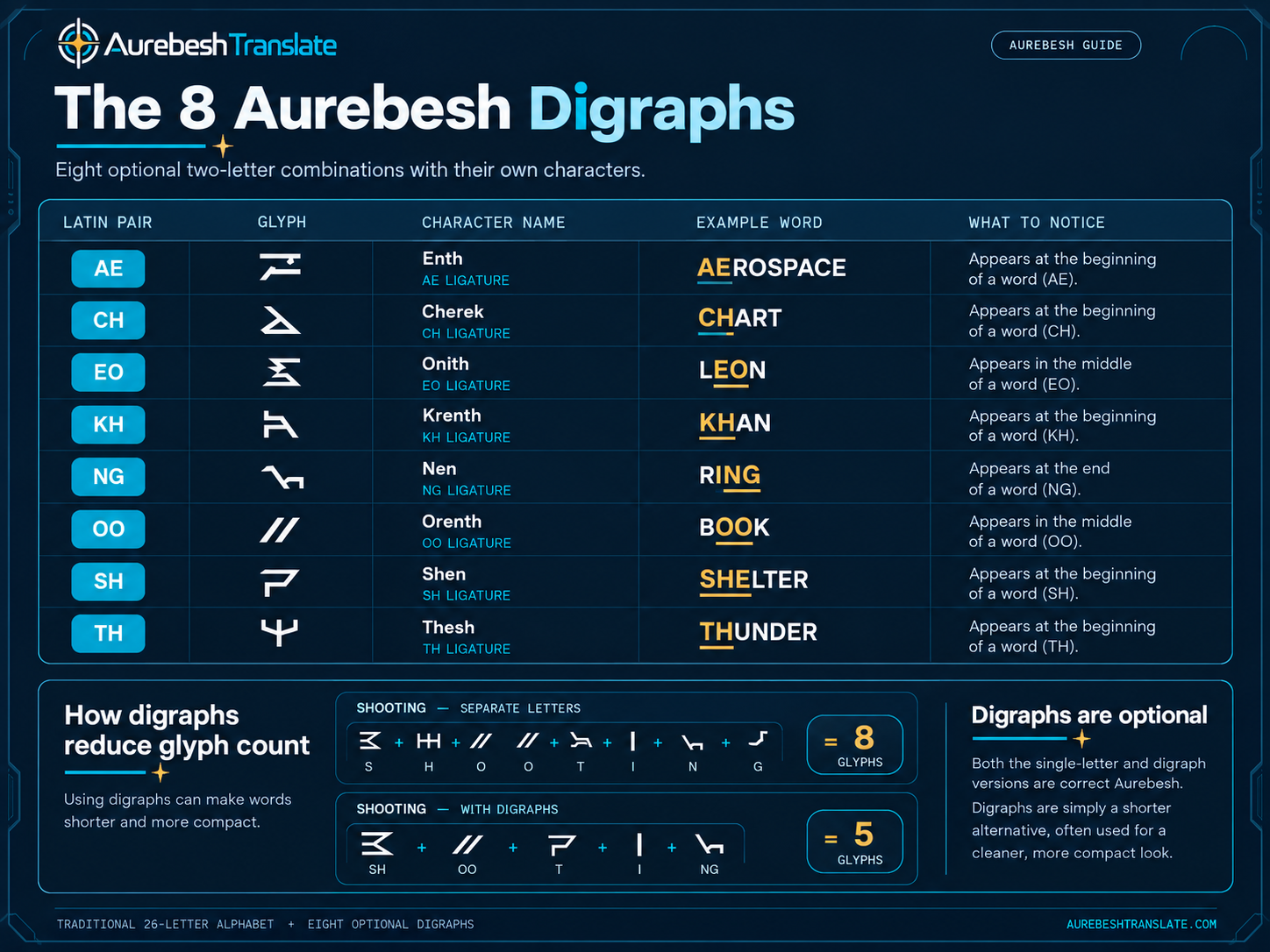
Aurebesh digraphs are eight special characters that can represent two Latin letters with a single Star Wars alphabet symbol. The traditional set covers AE, CH, EO, KH, NG, OO, SH, and TH. They supplement Aurebesh’s 26 basic letters, but using them is optional.
Consider LOOKING. Written with individual letters, it needs seven symbols. With Orenth for OO and Nen for NG, it can be grouped as L + OO + K + I + NG, requiring only five. Both versions spell LOOKING. The difference lies in how its letters are represented, not in the word itself.
The Eight Traditional Aurebesh Digraphs
Each of the eight characters has a conventional name, just like the basic letters. The table below identifies the Latin pair represented by each symbol and gives an example containing those two letters.
| Latin pair | Character name | Example | Where the pair appears |
|---|---|---|---|
| AE | Enth | AEROSPACE | The opening AE |
| CH | Cherek | CHART | The opening CH |
| EO | Onith | LEON | The middle EO |
| KH | Krenth | KHAN | The opening KH |
| NG | Nen | RING | The ending NG |
| OO | Orenth | BOOK | The middle OO |
| SH | Shen | SHELTER | The opening SH |
| TH | Thesh | THUNDER | The opening TH |
The examples demonstrate written pairs, not a promise that each pair has one fixed pronunciation. AE, EO, and KH are less common in everyday English spelling than SH or TH; they are nevertheless part of the established eight-character repertoire.
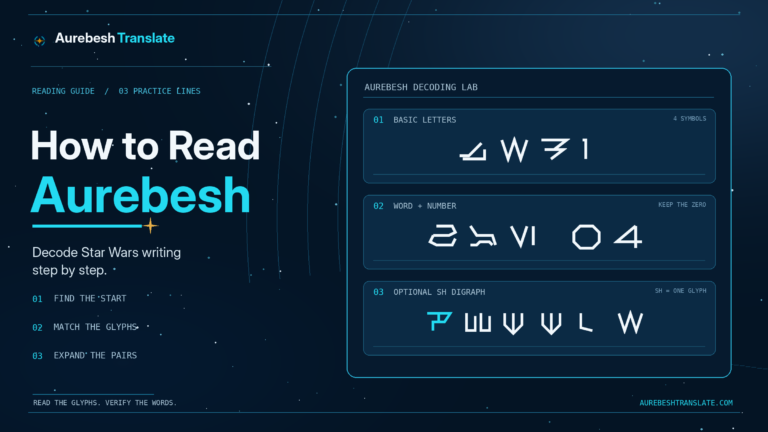
The interactive Aurebesh alphabet lets you inspect the actual shapes of all eight symbols alongside their names and English equivalents. This article concentrates on recognizing and choosing the combined forms in real words.
How One Digraph Changes a Word’s Character Count
A basic Aurebesh character stands for one Latin letter. A digraph character stands for a pair, so the number of visible Aurebesh glyphs can be smaller than the number of letters in the word.
Take SHOOTING:
- With separate letters: S + H + O + O + T + I + N + G — eight glyphs.
- With all three matching digraphs: SH + OO + T + I + NG — five glyphs.
In the second version, Shen represents SH, Orenth represents OO, and Nen represents NG. On reading the word back into Latin letters, those three characters expand into their respective pairs, recovering SHOOTING.
This also explains why counting symbols is an unreliable way to guess a word’s English length. A five-glyph inscription might contain more than five Latin letters. The reliable method is to identify each symbol, expand any digraph, and then read the resulting letter sequence.
Are Digraphs Required in Correct Aurebesh?
No. The traditional eight digraphs are recognized alternatives to writing their constituent letters separately. A word containing TH does not become incorrect merely because it uses Trill followed by Herf instead of the single Thesh character.
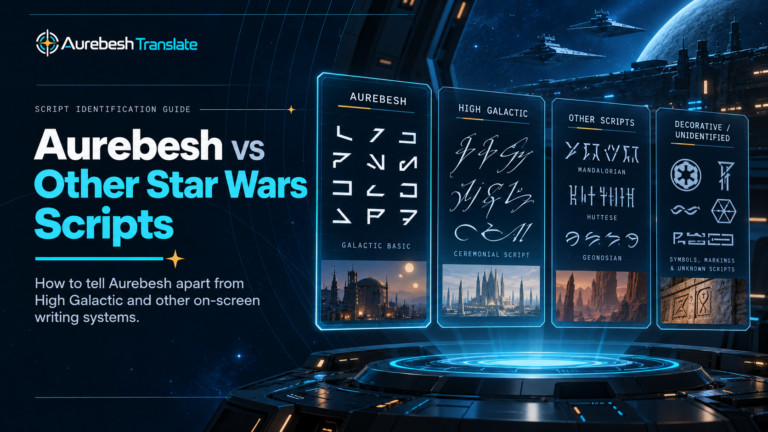
For THRONE, both T + H + R + O + N + E and TH + R + O + N + E recover the same six-letter word. Likewise, SHELF may begin with separate S and H symbols or with a single Shen character. The forms can even appear inconsistently across different Star Wars publications or fonts. One piece of lettering may employ combined symbols while another spells every pair with individual letters. For accuracy, check the actual characters against the intended word rather than treating the absence of ligatures as a spelling error.
A useful distinction is validity versus consistency. Both ways of representing SH can be valid, but a finished sign or document often looks more deliberate when it follows one chosen convention throughout.
A Matching Letter Pair Is Not Always One Spoken Sound
The eight Aurebesh symbols are commonly described by their Latin-letter pairs, yet English spelling and pronunciation do not align perfectly. Two adjacent letters can occur across syllable or word-part boundaries without functioning as a single sound.
For instance, MISHAP contains the letters S and H next to one another, but they fall in mis + hap. Its SH is not pronounced like the SH in SHELF. Likewise, the two O letters in COOPERATE normally belong to separate vowel sounds rather than the one vowel sound heard in BOOK or MOON.
A purely letter-based display may combine either pair because the characters are adjacent. A person preparing a carefully considered inscription may instead prefer separate basic letters where the combined shape could suggest an unwanted pronunciation or obscure a word boundary.
Pronunciation does not offer a simple universal rule, either. The OO spelling itself represents different vowel sounds in MOON, BOOK, and BLOOD. It would be misleading to describe Orenth as a character for only one English vowel sound. Its conventional written correspondence is OO.
For names and borrowed words, decide on the Latin spelling first. KHAN contains the KH pair and can use Krenth; a name containing a similar sound but spelled differently does not acquire a KH pair automatically.
The practical principle is to distinguish what letters a character represents from whether that combined shape is a good choice for a particular word.
Why Different Sources Display the Same Word Differently
An inscription, a character chart, and a digital font can all use the traditional Aurebesh alphabet while making different choices about its extra symbols.
Some lettering is drawn or assembled from individual characters. Other layouts substitute one combined glyph for certain letter pairs. In typography, that substitution is often called a ligature: the font draws one glyph while the underlying editable text can remain two letters.
Our downloadable AurebeshTranslate Regular font includes the eight combined forms as optional OpenType discretionary ligatures. An application that supports the dlig feature may display those glyphs when the feature is enabled; without it, the individual letters remain available. Microsoft’s OpenType documentation on discretionary ligatures describes that feature and its normally disabled default.
The Aurebesh fonts page covers installation and desktop compatibility. If you want to choose how a particular message looks while composing it, the Aurebesh keyboard provides a dedicated optional-digraph display setting.
The presence of one symbol instead of two should not, by itself, be treated as evidence that the underlying Latin spelling changed.
Common Errors When Working With Aurebesh Digraphs
A few checks prevent most confusion:
- Do not treat every pair of letters as an established digraph. GH, PH, CK, and EE are not among the traditional eight Aurebesh combinations.
- Do not read a combined symbol as one Latin letter. Cherek expands to CH, not C alone; Nen expands to NG, not N alone.
- Do not assume two basic letters are wrong. Writing Nern followed by Grek instead of Nen is an acceptable way to represent NG.
- Do not rely on glyph count to establish spelling. A word using several combined characters may have noticeably fewer visible symbols than Latin letters.
- Do not force sound-based substitutions into an unrelated spelling. Aurebesh characters represent the written letters chosen for a name or word, not an automatically reconstructed pronunciation.
When something looks unusual, check the character names and expand the combined symbols before deciding whether the inscription is incorrect.
Practice Reading the Combined Characters
You can test your understanding without needing a full sentence. Read each sequence of Aurebesh character names, remembering that a digraph supplies two Latin letters:
| Character-name sequence | Recovered word | What to notice |
|---|---|---|
| Cherek · Esk · Senth · Senth | CHESS | Four glyphs, five Latin letters |
| Besh · Aurek · Nen | BANG | Nen supplies the final NG |
| Leth · Onith · Nern | LEON | Onith supplies EO in a name |
| Shen · Orenth · Trill | SHOOT | SH and OO each use one character |
These exercises illustrate the reading rule without suggesting that every real inscription must use combined forms. You can check the individual glyphs against the alphabet chart and try the same words with their basic-letter alternatives.
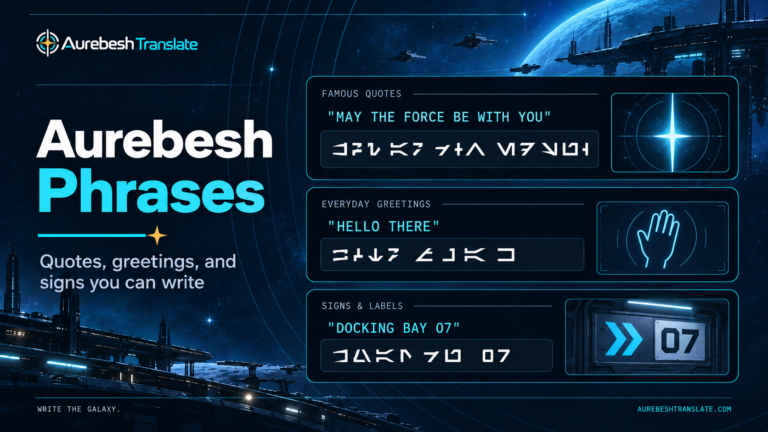
For a complete phrase, the Aurebesh translator provides the main text-conversion tool. When checking a specific inscription, the central question remains which Latin letters its symbols represent, including any of the eight optional pairs.