Aurebesh in Star Wars: Real Inscriptions Hidden in Films and Shows
Aurebesh appears throughout Star Wars on uniforms, equipment, computer displays, crates, and storefronts. Some examples carry straightforward information, such as a safety warning. Others hide a joke, a production reference, or a clue about a character. Once you recognize the lettering, these details stop looking like random science-fiction markings.
The examples below are tied to identifiable productions and documented readings. They are actual reported Star Wars inscriptions, not ordinary phrases converted into Aurebesh for illustration. The spelling and placement matter as much as the message: a word on a helmet serves a different purpose from the same word on a targeting display.
Notable Aurebesh Appearances and What They Say
| Star Wars production | Where to look | Documented reading | What the lettering does |
|---|---|---|---|
| The Last Jedi (2017) | Metal plate on DJ’s hat | DON’T JOIN | Reveals the codebreaker’s outlook and nickname |
| The Last Jedi (2017) | Canto Bight police helmets | CBPD | Identifies the Canto Bight Police Department |
| The Last Jedi (2017) | Resistance bomber ordnance | HI SNOKE; HAN SAYS HI | Adds crew-written messages to the bombs |
| The Clone Wars, “Cat and Mouse” | Yularen’s intelligence report | TARANCH | Preserves an earlier production name for Admiral Trench |
| The Clone Wars, “Defenders of Peace” | Separatist shield generator | CAUTION | Marks hazardous equipment |
| Rebels | Shop and advertising signs | REPAIR RACK; EAT AT KOE’S | Makes a marketplace feel commercially active |
| Resistance, “Signal from Sector Six” | Damaged freighter crates | CAUTION: HANDLE WITH CARE | Turns background cargo into readable warning labels |
| Resistance, “The Core Problem” | First Order probe’s viewpoint | TARGET | Labels an element of an on-screen interface |
These are selected, verifiable examples, not an exhaustive list of every Aurebesh mark shown in Star Wars. Capitalization in the table is for quick reading; it should not be taken as an exact reproduction of the lettering style, punctuation design, or capitalization of every source.
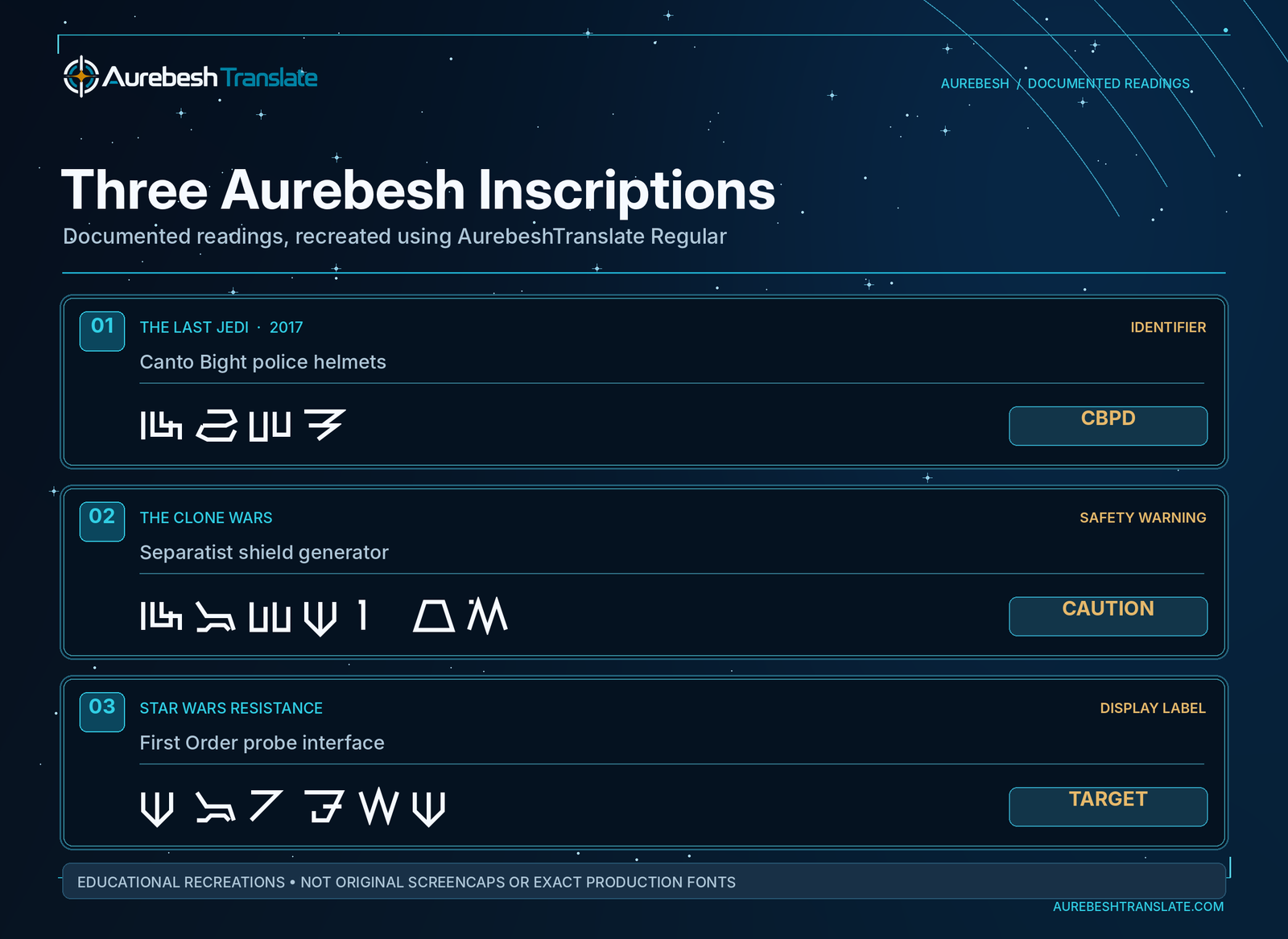
The graphic recreates three of the documented readings using this site’s AurebeshTranslate Regular font. It is an educational reconstruction, not a screenshot or a claim that the original productions used this exact font. You can check the individual character shapes in the Aurebesh alphabet reference.
The Last Jedi: Aurebesh as Characterization and World-Building
A particularly rich set of examples appears in Star Wars: The Last Jedi. Unlike an anonymous control-panel display, several inscriptions belong to recognizable people or institutions. Their wording makes the visual detail meaningful even if viewers never pause to read it.
DJ’s Hat Says “Don’t Join”
The metal plate on DJ’s hat carries the motto DON’T JOIN in Aurebesh. The phrase explains his nickname and matches the codebreaker’s refusal to commit to either side of the conflict. Its placement matters: he effectively wears his personal philosophy where everyone can see it, but only someone who can read the script gets the message immediately.
This is a strong example of writing contributing to characterization. The phrase is more than an atmospheric label on a wall; knowing its meaning changes how the viewer understands the character’s presentation. Lucasfilm’s official discussion of The Last Jedi Visual Dictionary confirms both the hat inscription and several other examples from the film.
Canto Bight Police and Resistance Bombers
Canto Bight officers wear CBPD on their helmets, identifying the city’s police department. A further design detail makes this especially interesting: the letters can be projected backward for visibility in a rearview mirror. That is a deliberate in-world use of reversed lettering, not evidence that every Aurebesh inscription should be read right to left.
The Resistance bombers contain a different kind of writing. Two pieces of ordnance carry handwritten crew messages, including HI SNOKE and HAN SAYS HI. These short inscriptions are personal and irreverent, unlike the official police abbreviation. Rose Tico’s borrowed First Order officer uniform also carries TARKIN on its armband, giving a small piece of costume lettering a specific name.
Seen together, the examples show why the text should be interpreted in context: an institutional abbreviation, a personal motto, a joke, and a uniform identifier are all doing different jobs.
The Clone Wars: Warnings and a Production Easter Egg
In “Defenders of Peace,” the Separatists’ shield generator carries the straightforward warning CAUTION. Reading it does not reveal a hidden plot twist. It makes the machinery seem engineered and labeled for people working around it, which is exactly what a believable industrial marking should do.
“Cat and Mouse” offers a more unusual example. An intelligence report consulted by Admiral Yularen contains the name TARANCH in Aurebesh, even though the character is known as Admiral Trench. According to the official Clone Wars rewatch notes, Taranch was an earlier production name that remained visible in the report. In other words, the hidden word preserves a small trace of how the episode was made.
Other inscriptions can have a lighter purpose. The bounty hunters’ speeder bikes in “R2 Come Home” contain a brief impatient message. These details reward viewers who pay attention to objects that the story does not stop to explain. The important distinction is between a production-documented reading and a fan’s interpretation of an indistinct graphic; they are not equally certain.
Star Wars Rebels: Shops, Advertising, and Everyday Life
The streets and marketplaces of Star Wars Rebels provide a different use for Aurebesh. Instead of military warnings, the lettering builds the texture of ordinary commerce. Signs advertising REPAIR RACK and EAT AT KOE’S have been discussed by author Dan Wallace in StarWars.com’s interview about The Art of Star Wars Rebels.
That approach works because a town needs more than architecture to feel occupied. A repair business, a place to eat, and a label on a shipping crate imply routines that continue when the principal characters leave the frame. The wording does not have to carry a mystery; its specificity gives the environment a sense of lived-in history.
For fans examining background signs, this also provides a useful check against overinterpretation. An apparent shop name should be identified from its visible characters and surrounding scene, not reconstructed from what a fictional market ought to sell.
Star Wars Resistance: Text That Actually Communicates
Star Wars Resistance makes frequent use of readable Aurebesh on technical equipment. In “Signal from Sector Six,” broken cargo crates on a derelict freighter bear CAUTION: HANDLE WITH CARE. The message is a sensible safety instruction for fragile or dangerous cargo, and its placement fits the object’s purpose.
In “The Core Problem,” a First Order probe’s viewpoint displays TARGET. Here the lettering does not belong to a physical sign at all: it is part of an interface telling the viewer what the machine is identifying. “Into the Unknown” offers further operational wording, including DIAGNOSTICS ERROR on a holographic display and DANGER: LOW GRAVITY on engineering screens.
These examples show Aurebesh functioning at three scales: printed warnings attached to objects, interface labels that describe a machine’s focus, and diagnostics that report an environmental condition. They also underline why a transcription must preserve short words such as low, error, and care. Omitting one changes the information the screen is supposed to convey.
Beyond the Screen: Aurebesh in Galaxy’s Edge
The same readable-lettering approach is used in Star Wars: Galaxy’s Edge, where visitors encounter signs and notices within the fictional Black Spire Outpost. Disney’s Play Disney Parks experience has included a translation tool designed to help visitors decode Aurebesh in the land. StarWars.com specifically describes using it to read signs and the message board in Oga’s Cantina.
This is a different kind of use from a fleeting film shot. In a physical environment, someone can stand in front of a sign long enough to decode it, and the act of reading becomes part of exploring the setting. The lettering is no longer just background decoration visible to a camera; it can be an optional activity for the visitor.
Why Not Every Star Wars Symbol Is Readable Aurebesh
The presence of angular markings does not guarantee a valid Aurebesh transcription. Star Wars has used decorative technical graphics, alternate visual styles, and entirely separate scripts. Some older film displays also predate the publication of the consistently mapped alphabet.
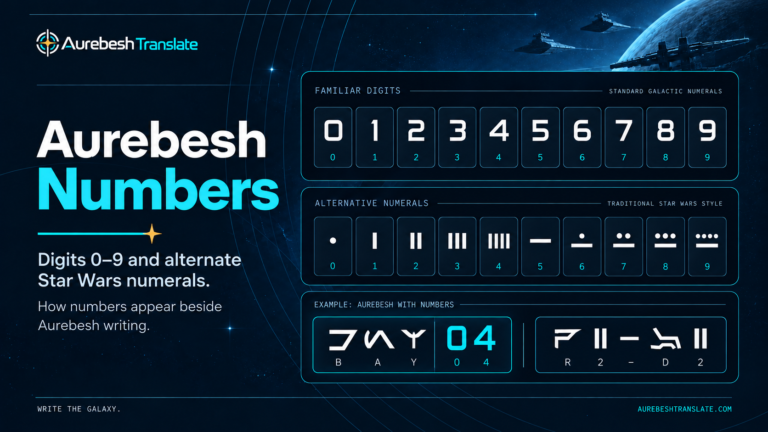
Even genuine Aurebesh can vary between productions. A character may be mirrored, widened, compressed, or drawn in a different font. A code can mix letters with numerals. What matters is whether the visible symbols support the proposed reading. The history of Aurebesh explains the difference between early screen-inspired symbols and the later systematic alphabet; repeating that chronology is not necessary to assess individual inscriptions here.
A particularly telling contrast comes from Revenge of the Sith: production set diaries reproduced by StarWars.com describe cockpit labels rendered in ordinary English rather than Aurebesh. Screen design was never governed by a rule that every interface in the galaxy had to use the same script.
How to Verify an Aurebesh Easter Egg
When you encounter a claimed hidden message, begin with the production and the specific object. “Aurebesh in The Clone Wars” is too vague to verify; “Yularen’s intelligence report in ‘Cat and Mouse’” identifies a source that another reader can examine.
Next, separate three kinds of evidence:
- Visible lettering: a sufficiently clear frame or photograph showing the actual marks.
- Documented reading: a production guide, creator comment, or official episode note identifying the wording.
- Interpretation: what a viewer believes the text says or why it was included.
A documented reading can establish the intended message even when a tiny on-screen inscription is difficult to see. A fan reconstruction may be a useful lead, but it should not be presented with the same certainty. Likewise, a font-made recreation can demonstrate the spelling without proving the exact shapes used in the original scene.
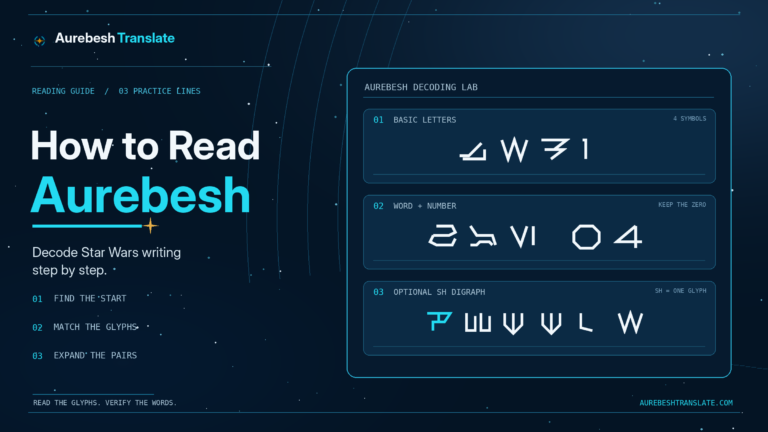
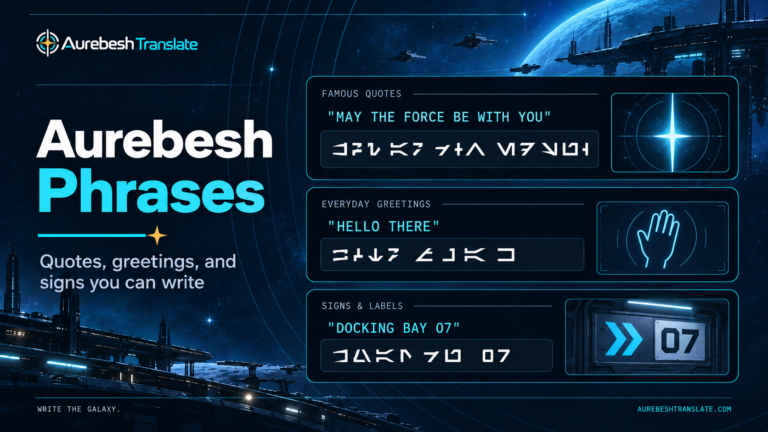
If you want to inspect a particular screenshot yourself, follow the method in How to Read Aurebesh: identify the glyphs, preserve spaces and numbers, and mark uncertain forms before forming a word. The Aurebesh translator can help compare a recovered Latin spelling with one rendered version of the script; it does not automatically extract text from images. For familiar sayings rendered into Aurebesh for your own use, see Aurebesh phrases, where created examples are explicitly distinguished from authentic screen inscriptions.
What the Real Inscriptions Reveal
The most interesting Aurebesh details are often the ones with a clear reason to exist. DON’T JOIN reflects a character’s beliefs; CBPD establishes an authority; CAUTION makes machinery credible; TARANCH preserves a production-stage detail; and shop signs give an animated town an everyday economy.
Reading them adds another layer to Star Wars without requiring every viewer to understand the lettering. A background inscription can communicate a joke, identify a place, or reward closer attention—and its meaning is strongest when the actual source, wording, and context all agree.