Aurebesh vs. Other Star Wars Scripts: How to Tell the Writing Systems Apart
Aurebesh is not the only writing system in Star Wars. The galaxy also uses Latin-looking High Galactic lettering, distinctive Mandalorian characters, local writing systems such as Ghorman’s, and ancient inscriptions associated with Jedi and Sith sites. They are not simply alternate fonts for one universal alphabet.
The useful question is not just what does this symbol look like? It is what writing system is being used, and what evidence would let you read it? Recognizing that distinction prevents an Aurebesh chart from being applied to letters that belong to something else—or to decorative marks that may not be letters at all.
Aurebesh and Other Star Wars Writing Systems Compared
| Writing system or example | What distinguishes it | Can an Aurebesh chart decode it? |
|---|---|---|
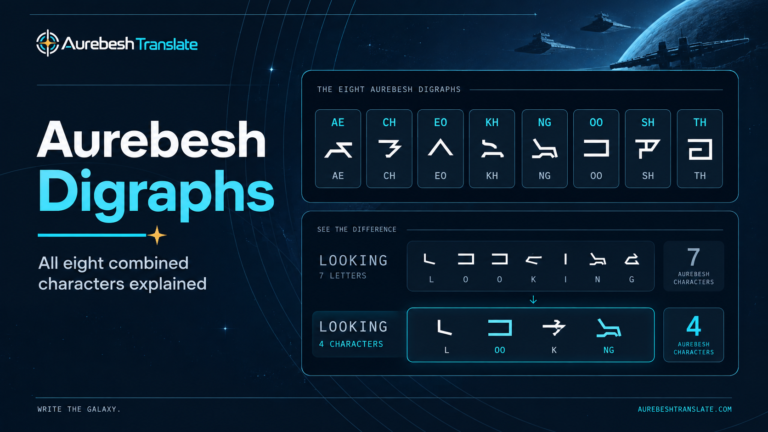
| Aurebesh | Established letter correspondences for Galactic Basic, including 26 basic letters and eight optional digraphs | Yes, when the inscription uses recognizable Aurebesh forms |
| High Galactic alphabet | Latin-looking lettering used to represent Basic in Star Wars material | Not needed for familiar Latin letters; it is a different script tradition |
| Mandalorian writing | A distinct visual alphabet associated with Mandalorian culture; not interchangeable with Aurebesh | No; use a source-specific Mandalorian character reference |
| Ghorelle and Dixian | Two written forms created for the Ghor language in Andor Season 2 | No; their writing is tied to a different language |
| Lanais cuneiform | Bird-foot-inspired marks associated with the Lanais on Ahch-To | No; it is a separate local writing system |
| Ancient temple inscriptions | Designs associated with Jedi and Sith sites, including motifs developed from Ralph McQuarrie’s artwork | Not by default; the marks require their own documented interpretation |
This is a comparison of specific documented examples, not a complete catalog of every script in Star Wars. Different productions also use altered letterforms, so appearance alone is not always enough for a confident identification.
Aurebesh vs. High Galactic: Two Ways to Write Basic
Aurebesh provides unfamiliar-looking glyphs for the letters used to write Galactic Basic. A word such as REBEL can be represented by Resh, Esk, Besh, Esk, and Leth. Its meaning and spelling have not changed; the visible letter shapes have.
High Galactic is a name used in Star Wars continuity for a Latin-looking writing tradition. The term helps explain why recognizable Roman letters appear in some in-universe documents, displays, and publications despite Aurebesh’s prominence. Its literary history has changed between older Expanded Universe material and later canon, so it is unwise to assume that every English-language label in every release has exactly the same fictional explanation.
The practical difference is immediate: if a display reads REBEL in ordinary Latin characters, you can already read its letters. If it displays recognizable Aurebesh glyphs, the Aurebesh alphabet chart provides the correspondence. Neither situation requires inventing different words in Basic.
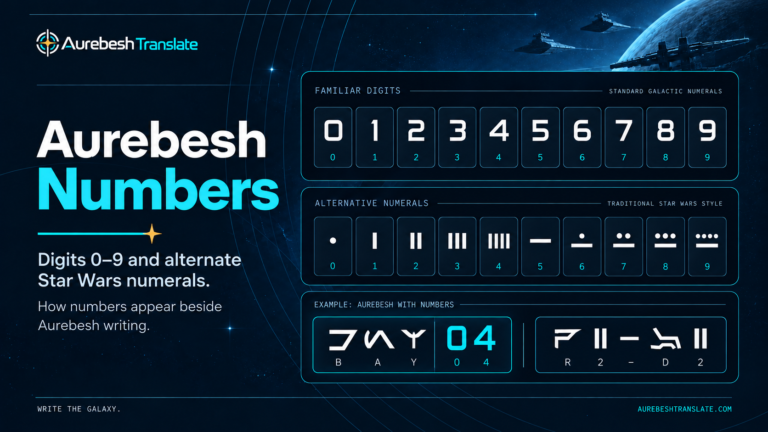
The same screen can also contain numerals, logos, or technical marks alongside the text. Their presence does not automatically make the entire display a third writing system.
Mandalorian Script vs. Aurebesh—and Why Mando’a Matters
Mandalorian writing is a separate set of letterforms, developed for the displays of Jango Fett’s ship in Attack of the Clones (2002) and reused in later Star Wars material. Production artist Philip Metschan is credited with the early screen designs. Its visual identity is different from Crane’s Aurebesh, and a similar angular appearance is not evidence of a shared character mapping.
A further distinction is essential: Mando’a refers to a Mandalorian language, while Mandalorian script refers to writing. The familiar spoken and written vocabulary of Mando’a developed through later Star Wars games and fiction; the screen lettering and the language did not emerge as a single complete system at the same time.
That means there are two separate tasks someone might call “writing in Mandalorian”:
- Changing the script: keeping English words but displaying their letters in a Mandalorian-style alphabet where a documented mapping supports it.
- Changing the language: expressing the intended meaning in Mando’a, which requires knowledge of its vocabulary and grammar, then choosing how to write the result.
An Aurebesh rendering of an English phrase accomplishes neither of those tasks. It remains English or Basic written in Aurebesh. Similarly, seeing a mythosaur skull or another Mandalorian emblem on armor does not establish that the emblem is an alphabetic character. An insignia and a sentence serve different functions.
Ghorman Writing in Andor: A Different Language, Not Just Different Letters
Andor Season 2 offers one of the clearest modern counterexamples to treating all Star Wars writing as a Basic substitution cipher. Its production team developed Ghor, a spoken language for the people of Ghorman, and two written forms: Ghorelle (High Ghor) and Dixian (Low Ghor).
Lucasfilm identifies dialect coach Marina Tyndall with the development of spoken Ghor. It also credits the names of the two written forms to graphic designers Elle McKee and Lauren Dix. The official Andor Season 2 production trivia specifically notes that Ghor cannot be interpreted merely by applying a Galactic Basic letter mapping: understanding its spoken component matters.
This is a fundamental difference from the usual Aurebesh reading exercise. With a clear Aurebesh sign, identifying its glyphs may recover an immediately recognizable Basic sentence. With a Ghorman inscription, even a correct identification of the writing system does not supply the Ghor vocabulary needed to understand the message.
It would therefore be misleading to label a guessed line of Ghorelle or Dixian as an “Aurebesh translation” simply because both appear within the same fictional universe.
Lanais Cuneiform and Ancient Jedi–Sith Temple Writing
Two other documented examples show how diverse Star Wars lettering can become.
The Lanais’ Bird-Foot-Inspired Cuneiform
The Lanais, the caretakers associated with Ahch-To in The Last Jedi, have a cuneiform writing system based on the shapes of their birdlike feet. The film’s accompanying Visual Dictionary, discussed by StarWars.com, identifies a clay chopping board as a place to examine this writing.
The significance here is not that the marks resemble a particular Aurebesh letter. Their shapes come from a different design concept and belong to a different local tradition. An Aurebesh A–Z chart is the wrong tool for deciphering them.
Older Temple Markings Are Not Automatically a Sith Alphabet
In Star Wars Rebels, markings on the Malachor Sith temple draw on ancient-looking writing originally designed by Ralph McQuarrie and also used on the Lothal Jedi temple. Lucasfilm’s episode trivia explicitly connects those designs.
This is good evidence for the design relationship between the inscriptions, but it does not mean every visible mark can be assigned a known Latin letter or that any striking red or angular symbol is a readable Sith sentence. Certain reference materials discuss Sith languages and their written forms; that is a different claim from proving that a particular frame contains a fully transcribable message.
Whenever a script is known mainly through a scene or an artwork reference, distinguish a documented reading from a speculative fan-made alphabet chart.
Alien Languages, Droidspeak, and Emblems Are Not Interchangeable With Scripts
A fictional language is a system for expressing meaning; a writing system is one way to record language. The distinction matters in Star Wars because many memorable forms of communication are heard rather than seen.
Huttese, for example, is the spoken language associated with Jabba the Hutt and other characters. Its dialogue was developed for performance and sound design. The existence of Huttese speech does not prove that a random set of symbols on a Tatooine wall is written Huttese, nor does it make Aurebesh a Huttese dictionary. A written form may be depicted in particular sources, but it needs to be established from that source.
Droid beeps and electronic signals may carry information without representing a line of printed alphabetic characters. Likewise, a clan emblem, the Jedi Order symbol, or an Imperial insignia may communicate identity without spelling a word.
The mistake is to group languages, alphabets, pictorial symbols, and sound-based communication under one supposed “Star Wars font.” Their boundaries affect what can actually be decoded.
How to Identify an Unknown Star Wars Inscription
When the script is uncertain, make a classification before attempting a translation. The sequence below avoids the most common false readings.
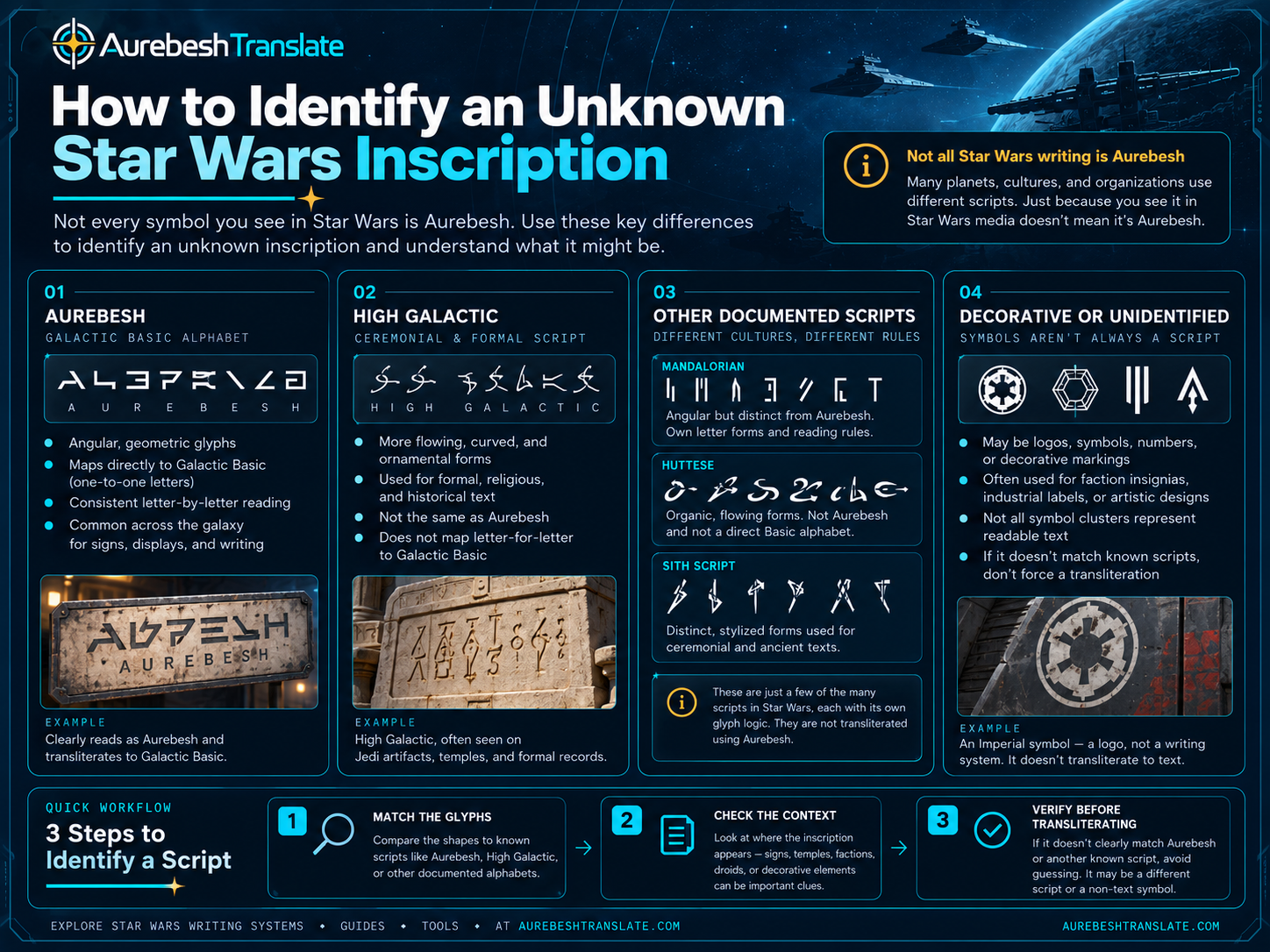
- Identify the object and production. Is the writing on a Mandalorian cockpit display, a Ghorman shopfront, an Ahch-To artifact, or an ordinary galactic sign? Location is a clue, not final proof; characters can encounter writing from other cultures.
- Check for a real Aurebesh correspondence. Compare several consecutive marks with the 26 basic letters and eight optional digraphs. One vague resemblance is weak evidence; several matching characters in a consistent order are much stronger.
- Test the word without forcing it. Transcribe the characters you can actually identify. If the result requires repeatedly inventing or reversing individual glyphs to make a plausible English word, reconsider the script.
- Look for a documented alternative. A confirmed Mandalorian alphabet, Ghorman writing, or another local system needs its own reference—and in some cases an understanding of the underlying language.
- Leave unverified symbols unresolved. A crest, interface decoration, or insufficiently clear inscription should not be given a confident invented translation.
For example, a readable cargo label that matches Aurebesh glyphs and yields SUPPLIES is good evidence for that script. A cluster of symbols on a Mandalorian helmet is not automatically Aurebesh or Mando’a. First determine whether the marks are text or insignia, and whether their forms match a documented alphabet.
If you already know that the inscription is Aurebesh but some letters are difficult to identify, use How to Read Aurebesh for a careful transcription method. For verified examples from films and television, Aurebesh in Star Wars examines inscriptions in their original contexts.
What the Aurebesh Translator Can—and Cannot—Convert
The site’s Aurebesh translator is built around Aurebesh character correspondences. It can display Basic or English-letter text with that writing system and help reverse a supported glyph sequence into Latin letters. That does not make it a general translator for Mando’a, Ghor, Huttese, ancient temple scripts, or unrecognized symbols in photographs.
Even within Aurebesh, a particular font may use different styling or optional combined characters. These differences do not create an entirely new script; the relevant test is whether the underlying letter identities are still Aurebesh. The Aurebesh Unicode and copy-and-paste guide explains why a font’s appearance and the characters stored in a document can differ.
The safest rule is to identify the writing system before choosing a translator. If the symbols match Aurebesh, its chart and converter are appropriate. If they belong to another documented tradition, use evidence specific to that tradition. And if the markings are only decorative or unresolved, it is more accurate to leave them undecoded than to manufacture an English message.